Oops, I nearly forgot!
After buying the lovely things from the shop, I walked out and then realised I had forgotten to get something for my Mum. So I went straight back and as the ladies looked up at me (I had spent an inordinate amount of time deciding what to buy), I said I forgot to buy something for my mother. I didn't take long this time around, found a lovely purple eye glasses case and I was finished.
One thing I do know, next time I'm there, I'll be able to make my mind up far more quickly - oh yes, I definitely plan to return to Siem Reap. Now...if I could just refill my pocket up quickly! I'm keeping an eye out for "specials" - cheap flights from Melbourne to KL.
Time for a cuppa
As I stepped out of the shop door for the last time, I thought I'd love to sit under the trees and have a tea or something. There was a lovely little cafe in the garden and a gazebo with timber table and chairs. The weather by now was very hot indeed, and I bought an icecream. Not the shop bought stuff like Peters or Streets - no, this was the real thing - home-made icecream. Cambodian ice-cream is delicious. I bought a local fruit variety. From memory, it was one ringott 50 sen.
Above: Outdoor dining area
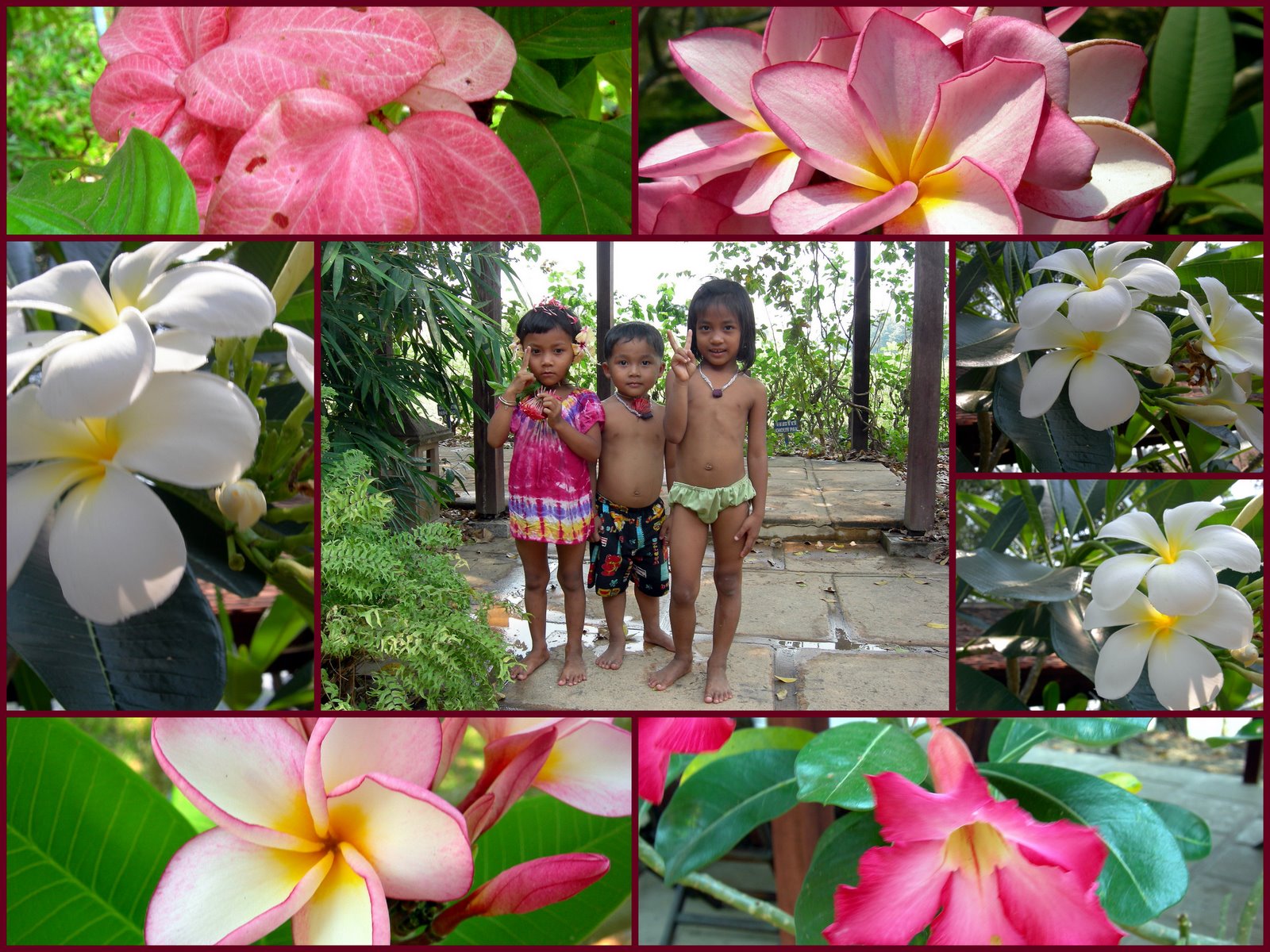
This is where I sat while enjoying the most delicious ice-cream. There was a faint breeze which while not cool, was nonetheless very pleasant. Especially sitting in the shade inhaling the fragrances of the flowers and gardens.
Above: Silk Farm gardens
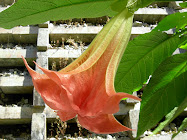
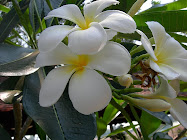
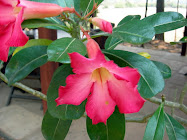
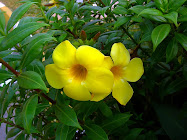
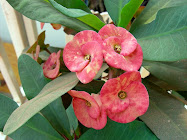
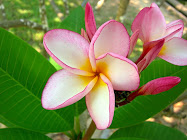
As you can see, there are a couple of undercover picnic areas here with lush gardnes full of greenery, Hibiscus and Frangipani - everywhere you look in Cambodia there is Frangipani. Such a lovely flower with velvety textured petals. Just as I was thinking I really should be gettign a move on, my driver Pookeah came across and I could see that he wanted to be off. The poor man, having to hang around and wait for me when he probably wanted to get home for lunch. I was a bit thoughtless I suppose and hadn't thought of this.
Above: Silk Farm Roadsign
After clambering back in the tuk tuk we set off and as we started to turn onto the road, I asked my driver if he could stop for me so I could take a photo of the sign. He did and I did then we were on our way. Funny thing, the drive back seemed to take no time at all - no more touring around, we went straight back to the Two Dragons.
I had had a lovely time, seen some amazing things, bought some of the most beautiful hand made items and was very happy. It was really relaxing just sitting down and being driven along - not a care in the world. It's a nice feeling.
I would recommend anyone going to Siem Reap to visit the silk farm at Artisans d'Angkor, it is well worth it and even if you're on a very tight schedule, do make the effort to go there - you won't be disappointed.
Malaysia Time
Click On Your Flag To Translate
Malaysia and Cambodia
Hello,
This is about my upcoming trip to Malaysia and Cambodia. The first part is pre-trip - information about flights, itineraries, accommodation and all the things that you need to do to plan an overseas holiday. This is my first trip to Asia and I hope it may help others. Comments are very welcome and anyone who has travelled to Malaysia and/or Cambodia, please feel free to comment and offer any advice or tips that you think would be helpful. As of today ( 28th February) , in exactly 11 days (minus 30 minutes) I will be in Kuala Lumpur.
Cheers.
I had the most amazing time and hope you enjoy reading about my trip. Each post is numbered and I'm doing them in order from start to finish - a little like a diary.
ANGKOR WAT SUNRISE
This is about my upcoming trip to Malaysia and Cambodia. The first part is pre-trip - information about flights, itineraries, accommodation and all the things that you need to do to plan an overseas holiday. This is my first trip to Asia and I hope it may help others. Comments are very welcome and anyone who has travelled to Malaysia and/or Cambodia, please feel free to comment and offer any advice or tips that you think would be helpful. As of today ( 28th February) , in exactly 11 days (minus 30 minutes) I will be in Kuala Lumpur.
Cheers.
I had the most amazing time and hope you enjoy reading about my trip. Each post is numbered and I'm doing them in order from start to finish - a little like a diary.
Showing posts with label J Artisans d'Angkor. Show all posts
Saturday
48. Artisans d'Angkor 3 - Silk Museum and Shop
The Finished Product
Above: Colours worn by Khmer Royalty for each day of the week
These are the colours worn by Khmer Royalty - a different one for each day of the week. Starting from the left, the pink was worn on Mondays, the orange of Tuesdays, the royal blue on Wednesdays, the green on Thursdays and so on. I remember thinking at the time, what a marvellous idea, you wouldn't have the problem of "What should I wear to the party?" - you'd just go with the colour of the day. An eminently suitable idea too, think how easy it makes it to match handbags and shoes!
Above: Cambodian traditional dress
As we were moving along I saw these lovely clothes which are the traditional Cambodian style of dress, although I think many people today wear a more modern style, they still retain some of the traditional styling in the way the garnents are cut.
The sampot is a lower-body, wrap around cloth and is the national garment of Cambodia. There are several variations of the sampot, each is worn according to class.
A regular sampot known as the sarong was about one and a half metres long and both ends were sewn together and tied at the waist. These were worn by men and women of lower class.
Sampot Chang Kben worn by ladies of middle and upper class, was 3 metres long and a metre wide. It was wrapped around the waist, stretching it away from the body and twisting the knot which was then pulled between the legs and held by a metal belt. Regardless of class, all Cambodian women wear the Sampot Chang Kben for special events. Men may wear it, but the traditional patterns depend on gender.
Above: Cambodian traditional Royal dress
As you can see, the clothing worn by Royalty is far different from that worn by the rest of the population. Notice the richly embroidered gold thread and the many sparkling jewels sewn on. Lovely though they are, you wouldn't be able to sit for long in them. And those head dresses would give you a headache and a half. They look pretty heavy to me - imagine having to wear one on your head all day. You'd be longing for nightfall just so you could get the thing off! Still, maybe the kings and queens didn't have to have them on all day.
Above: Silk Panels
I asked Bunneano if he could hold the silk panel out for me so as to get a better shot. These panels were at least 12 foot long and almost a metre wide and are woven so fine as to be almost sheer.
Above: Bed Cover
This lovely sample could be used as a bed cover and has at least seven or eight different colours running throughout. Below is a close-up.
Above: Closeup of the bed covering
Click on the photo to enlarge it and you can see the intricacy of the patterns. And it is all woven manually by hand.
Above: Framework
These were on the floor near the bed cover, I'm not sure what they are, but the vibrant colours were very striking.
I was hoping there were silk products available for sale, and yes, there is a largish shop with many lovely things. The ladies working there were very polite and friendly and didn't mind that I seemed to take forever making up my mind what to buy. I was like a child in a toy shop, there were so many, many beautiful things to choose from. I eventually settled on the gifts I would take back home with me - two coin purses, a ladies wallet, eye glasses case, two card holders, which was funny as I thought they were small rectangular coin purses!
Above: Purchases
I also bought a small evening bag which isn't shown here but was in a lovely shade of green called Anise. I had wanted a pink one but there were none left. For myself, I settled on a scarf and a handbag.
Above: Bag and scarf
I really liked two bags they were both the same but in different colours. The one I wanted was the same colour as the red striped wallet but I also liked the one in the above picture. I hummed and haa-ed over them, taking forever to make up my mind. I knew I should get the red/fuschia one because those colours suit me especially as I planned on buying a matching scarf. Yet something held me back and I ended up buying the one you see above with a blue/green scarf. The inside silk lining is more a green although it looks a bit yellowy in the photo.
The bag really looks quite elegant but I still wish I'd bought the red striped one. I wish I'd bought both bags, but like a lot of things in life, we think of these things when it's too late. The straw bag with the navy silk fabric down the middle is what the sales lady put mu purchases into. I thoguht this was a nice touch and so - I have another bag.
I couldn't get over the cost of the items - I thought they were very reasonably priced. Where would you get a hand woven silk handbag for US$49? It'd cost a lot more buying products of this calibre in western countries.
Friday
47. Artisans d'Angkor 2 - Yarn Preparation
From Cocoon to Yarn
We now move to the next phase of the silk making process - that of turning these furry little golden yellow cocoons into beautiful silk thread.
Above: Boiling the cocoons
Silkworm cocoons, known as golden silk, are boiled to help detach the silk from the worm. This process is called degumming and after it's done the cocoon goes into another boiling pot to have the fine silk layer fished out.
The girls working here all seemed very shy and let me take their photos. They were all very industrious and I could see the look of concentration on their faces. They really care about what they do and seem to take great pride in their work.
Above: Extracting the silk thread
The next stage - another boiling pot for the fine silk. It was so fine, I could barely see it - even though I had my glasses on. I swear it was so fine that even Superman with his X ray vision would have had difficulty. The guide lifted some threads up for me with the aid of tongs and let me feel it, remarking on how strong it was. It may be finer than the finest spiderweb, but the thread was very strong in spite of it's delicate look.
Above: Extracting the silk thread
Further on in the process, the extracted thread is spooled and wrapped on to big wheels to give it more tension.
Above: Spinning racks
The big chunks you see in the foreground is the raw silk - the yarn is wound on the spinning racks.
Above: Natural dyes
The silk is dyed naturally, using plant roots, extracts from plants, leaves and even bark and rusty nails to get the beautiful colours you can see here.
Above: Weaving
In this photo, the young girl is moving the shuttle (threaded with the silk thread) from left to right. I stood watching as she, and others wove the silk. The shuttle was moved from right to left, then the weaver places both hands on a piece of wood which is the width of the fabric and pulls this towards her, she then moves the shuttle from left to right, then pulls the wide piece of wood towards her again. This is repeated time and time again. It takes one day to weave one metre of silk.
There were several girls weaving, from the simplest of plain fabric to the more intricate patterns. One fabric which was very beautiful with many colours had fourteen different shuttles - one for each colour! The work is back breaking and the constant motion of moving the shoulders and arms would no doubt have me running for the nearest doctor with backache! Honestly, I didn't know how they could do this for it is arduous and not for the faint hearted.
And seeing these young women at work, gave me an insight as to why hand woven products are so highly prized. No machine could produce such beautiful fabrics and designs.
Above: Lunch!
As we moved along, I noticed these fish and thinking they were part of the dyeing process asked, "What sort of fish are they and what are they for?"
Bunneano looked at me and said, "Lunch!"
Oh, I felt like it was foot in mouth time!☺
46. Artisans d'Angkor 1 - Silk Farm
On the way
A few things that stand out in memory which I forgot to mention earlier, after visiting Preah Promreah and crossing over the bridge, we were driving along and crossed yet another bridge and as we turned right, my driver slowed down and made to pull over on the corner saying to me, "You want to visit the crocodile farm and do a tour?" to which I replied, "No". He turned his head and asked didn't I want to see the crocodiles? People like to see crocodiles. I told him, "No thanks Pookeah, we got crocs back in Darwin". Evidently, this was something he hadn't enctountered before and thought it strange that I wasn't interested.
No crocodiles thanks, I'm Australian!
How to explain Australia has plenty of crocs - big salties up around the Top End and FNQ? (Far North Queensland) - I remember when I went to Darwin, Kakadu and Arnhem Land and went to Litchfiled NP, the "Jumping Crocs" cruise on the Adelaide Queen was included and I was so excited at actually seeing them instead of just in pictures or on the telly. And of all the many photos I took trying to capture a decent shot. I didn't have a digital camera then and when I think of all the money I spent paying to get the film developed. Anyway, at other places I've been to on my travels around Oz, overseas tourists are amazed that I don't want to "See the crocodiles" - crocs, like anything else, you've seen one (croc) you've seen 'em all!☺
I have water
There were a number of little stalls along the way and I wanted to stop at least one of them, not so much because I wanted to buy anything, (although I would have purchased something, otherwise I'd have felt like a real heel), but more because I really would like to have sat and chatted with people. So, after seeing yet another stall with colourful umbrellas and children running around, I called out to my driver, "Oh, could we stop here please and go back there?" Pookeah asked me why, and I said the first thing that came into my head (well I thought too that it was a reasonable request and sounded much nicer than saying I just want to have a look around and mix with the locals) - I said I'd like to buy a bottle of water.
"You want water? Is no problem, I have water here." And with that, he stopped, hopped off, went around the back of the tuk tuk, lifted up a lid and produced a bottle of water. Damn! Naturally I thanked him and smiled. And made sure I didn't let the disappointment show on my face.
That's not the silk farm
Driving on and drinking my water and having a few fags along the way (one of the greatest things I noticed in Cambodia - people don't get in a tizzy when you smoke, not like back home where you're made to feel like a leper) I saw a place on the right hand side on a corner saying "Silk Farm" - there's the silk farm are we going to stop there? "No that's not silk farm". But it says silk farm says I, not there says my driver, silk farm is up this way. Not understanding why he didn't stop, I sat back and enjoyed the ride. It wasn't till we had gone for a further twenty minutes or so, that I understood - for there, with a big sign was the silk farm. And it bore no resemblamce to the other little place we passed.
The silk farm I later found out, is located about a 20 minute drive from Siem Reap in the Puok district. As my driver was taking me on a "countryside" tour, it took far longer than the said 20 minutes, and I got to see so much more because of it.
About Artisans d'Angkor
Artisan's d'Anglor began in 1998. It was created to help the young people to find work in their home villages by providing them with high skilled training and a vocation from which they can earn a living.
Above: Artisans d'Angkor
Over a thousand people are employed by Artisans d'Angkor today and the establishment of rural workshops has helped to slow down the rural depopulation of Siem Reap surroundings by increasing income of rural Cambodian families. Cambodia has long been famous for its silk, and much of the country and population was decimated during the reign of the Khmer Rouge. By supporting its people and enabling them to find work, the government is trying to get the country back on its feet and learning the almost lost art of traditional hand-weaving is a value which can be handed down for generations.
Teaching
At Chantiers-Écoles young girls from the villages are brought here and learn all about the silk process and how to weave. Many of them live a long way from the town of Siem Reap - about 15kms. The Cambodia government and the French government pay for this. They sleep at the school and have their meals there. They have to pass a test and when they do, they go back to their villages where they can get jobs as weavers. This is how it was explained to me by Bunneano who showed me around the farm.
Above: Bunneano my guide
My driver said he'd meet me "over there" when I came out and showed me where the entrance was. I walked up this path with lovely shady trees, to the door and this lovely young man introduced himself to me saying his name was Bunneano and took me on a tour of the silk farm.
Silk Farm Tour
Above: Entrance
This lovely shady entrance is a welcome retreat from the heat and is set in lovely gardens.
Above: Three Angels
As we walked along the path on the right hand side, these little children were playing and let me take their photo. I asked their names but didn't write them down. Something I noticed, whenever I asked permission to take a photo, whether in Cambodia or Malaysia, they always make the "V" sign with their fingers.
Above: Mulberry plantation
Next we went passed the Mulberry plantation - lots and lots of trees, there are eighteen species grown here. We have a white mulberry tree in our back yard at home which has white mulberrys which I'm told by my landlord are edible and taste very nice. I said this to Bunneano and asked was it the same. It isn't, it's a different one to the trees which produce the leaves the silkworms eat.
Above: Silkworm eggs
The female moth lays many tiny little eggs - as many as 300 at a time.
Above: 12 day old silkworms
A little caterpillar hatches out of the egg. The caterpillars above are twelve days old, steadily getting bigger and fatter from their diet of mulberry leaves. As they get bigger and bigger, they go through four molts. They eat for three days and sleep for one day.
Above: Cocoons
The caterpillars spin a cocoon of silk thread around themselves and inside the cocoon, the caterpillar changes into a pupa.
Above: Lifecycle of cocoons
Above: The silkworm room
Here are a number of "plates" with silkworms of varying ages on them busily eating blissfully unaware that their little lives are almost over and they will go on to become a silk scarf around your neck or a pair of silken slippers on your feet.
Above: Silkworm harvesting - the old way
When the cocoons are the right age, they are harvested. This was the old way of harvesting and they could often get caught on the rough bits of tiwgs.
Above: The new way
The newer, more modern method is far superior to that of the old.
Above: The new way
Twenty per cent (20%) of the silkworms bred are kept for breeding and to ensure reproduction, while the remaining eighty per cent (80%) are used to extract the silk thread. Did you know Cambodian silkworms are unique, as they are yellow in colour compared to white ones of other countries?
The next post is about the next stage in the silk making process.
Subscribe to:
Posts (Atom)