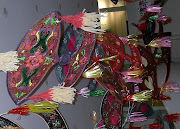
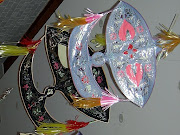
The Baba Nyonya Heritage Museum here is a must see. There are two ladies who do guided tours (the slimmer lady was really fun) and tours run for about 30-40 minutes. The museum is right in the middle of Chinatown and runs parallel to Jonker Street
About the Baba Nyonya Museum
The house was built in 1896, and was the family home of the Baba Chan family known as Rumah Abu. Chan Kim Lay, aged 83, is the fourth generation of his family.
It is in a well-preserved traditional Peranakan town house, built in 1896 by millionaire rubber planter Chan Cheng Siew. Today it is owned by William Chan and his family, who conduct tours of their ancestral home. The interior is that of a typical 19th-century residence and all the rooms are still as they would have been 100 years ago. The house contains family heirlooms and antiques, including Nyonyaware porcelain and blackwood furniture with marble or mother-of-pearl inlay, and silverware. There is also a collection of traditional wedding costumes, photographs and kitchen utensils. The kitchen sink has the name of William Chan's great grandfather carved on it. The information-packed tours are run regularly throughout the day.
Above: Baba and Nyonya
This cut out is to the left of the entrance door. You can see here the beautiful clothes that were worn at the time.
Sunday 21st March
Today's "sightseeing" was on the Chinatown side of the Malacca River. I asked Liz (part owner of Heeren House) the best route to take to avoid backtracking and the Baba Nyonya Heritage Museum was first on my "list" seeing as it was in Heeren Street, only just up the road from where I was staying. The metal security door was locked and you had to press the bell. A lady came, asked did I want to do a tour, the next one was starting in about 15 minutes and let me in. Price was a few ringitts. She said no photos were allowed inside the museum (you can take as many pics as you like of the outside though) This (she said) was because people came, took photos and made copies of the furnishings. At the end of the tour you can buy souvenirs. (I bought postcards and took photos of the postcards.)
Above: Baba Nyonya Heritage Museum
We learnt the fascinating history of the Baba Nyonyas who are descendants of the Chinese who came to Malaysia and married Malays. The offspring were the Baba (male) Nyonya (female). They are also known as ‘Straits-born Chinese’ or ‘Peranakans’. The Straits Chinese were of noble descent and adopted much of the Malay culture as their own. Elderly Chinese ladies were very conservative and would peek through the holes in the fancy carved timber to see who was in the room where the master of the house conducted his business affairs.
Above: Jee Ho
The Chinese signboard above the main door way is called a Jee Ho.
Above: Baba Nyonya Entrance
As we walked through the middle door (see in photo above), we learnt that the present owner who is the grandson (or the great grandson?) of the original owner had turned his family home into a museum some years ago and was about 70 or 80 years old, and though he might be "old" his brain is as sharp as a tack. The Chinese man who originally bought the house, bought one house first, then the second then the third and turned them into one house. Originally the entrance was the door of the house to the right but that has now been locked and the middle house has the entrance.
Above: The First Lady of the House
After walking in, we moved to the room on the right which is where business was conducted. Chinese ladies never took part in this and the wives of the business men sat in another room and played card games. The table had drink holders which could be pulled out from the table to hold cups/glasses. They must have been very bored playing cards and eating sweetmeats. A far different lifestyle than today.
Moving back into the centre and walking towards the back is a very large area with a sunken tiled area. There is no roof - houses were very narrow, had windows at the front only, so natural light was needed and was therefore necessary to have this area for when it rained, otherwise the house would have been flooded. Another interesting fact - the only door is at the front - there are no back doors. So bad guys had no way of entering the house. That is also the reason windows are at the front of the house only.
Moving toward the front of the house, just in front of the atrium is a beautiful staircase with carpet on the upper level. We were told to remove our shoes. The first part is circular and at the top on the right is a long hallway with sideboards displaying antiques. One of these held very, very old bottles of brandy and cognac. We were instructed not to sample them. Asking the tour guide if the taste would be better now due to age, she laughed and said she wasn't sure but nobody was game enough to try!
Above: Baba Nyonya carved furniture
CCTV
We may think we invented CCTV, but those Chinese invented it first! They were very smart - after climbing up the stairs, we were led to the area in the middle of the house near the front and instructed to look down. There was a small square about 6" (15 cms), our guide pulled something and lifted it off and there we had a view of the entrance door below. She explained this was how the master of the house determined who he would allow to come into his home - if he didn't like the look of you, a bowl of water would be tipped out over you, so always hold an umbrella over your head!
Bridal Chamber
Above: Bridal Chamber
The bridal chamber which you see above is a most magnificant bed with rich tapestries and furnishings. This is where the master of the house and his bride slept. There is a ceremony held first before they jump into bed. As marriages were arranged, the bride had only seen her bridegroom's face through the peephole before the wedding, the groom hadn't seen the bride at all and they needed to get to know each other first. Such a sensible idea really.
There was a large mirror a few feet from the bed, the bride sat on a chair near the bed and the groom would look in the mnirror to see the face of his bride. This way he was prepared should he be unlucky enough to have married an ugly lady! (As I mentioned, such a sensible idea don't you think?) After this, they would then sit at a table and partake of drinks and foods while they became comfortable with each other. The bed is quite small by today's standards as people were quite a bit shorter and smaller back in those days.
Above: Inside the museum
Coming out from the bridal chamber we moved to the left along a passageway to the children's rooms. This passage had windows which faced the front and we could see the courtyard below. There was a staircase off to the right and for safety and security there was a folding door which opened at the top staircase area and unfolded to seal off access. Very good if the husband had had a night on the town and wanted to sneak in. Also very useful if the lady of the house was annoyed with him - all she had to door was seal this off and the poor old husband had to spend the night outdoors!☺
Coming back down the stairs, putting our shoes back on we were led to the kitchens. Those poor servants had no modern day conveniences of today and must have been a very healthy bunch indeed. The master and his family ate at one table - there was another table (not nearly as glorious) where the servants ate. Beautiful china was arrayed and the more intricate the design, the wealthier the family. Blue and white china is used for funerals only. You can see in the above collage, top left hand photo, the pink floral china which was in use.
The owner of the house had had installed modern toilets near here which we could use, and souvenirs were in a smallish alcove. It was a most instructive tour and should I find myself in Malacca again, I'd definitely do the tour again.
Next: Chinatown
Malaysia Time
Click On Your Flag To Translate
Malaysia and Cambodia
Hello,
This is about my upcoming trip to Malaysia and Cambodia. The first part is pre-trip - information about flights, itineraries, accommodation and all the things that you need to do to plan an overseas holiday. This is my first trip to Asia and I hope it may help others. Comments are very welcome and anyone who has travelled to Malaysia and/or Cambodia, please feel free to comment and offer any advice or tips that you think would be helpful. As of today ( 28th February) , in exactly 11 days (minus 30 minutes) I will be in Kuala Lumpur.
Cheers.
I had the most amazing time and hope you enjoy reading about my trip. Each post is numbered and I'm doing them in order from start to finish - a little like a diary.
ANGKOR WAT SUNRISE
This is about my upcoming trip to Malaysia and Cambodia. The first part is pre-trip - information about flights, itineraries, accommodation and all the things that you need to do to plan an overseas holiday. This is my first trip to Asia and I hope it may help others. Comments are very welcome and anyone who has travelled to Malaysia and/or Cambodia, please feel free to comment and offer any advice or tips that you think would be helpful. As of today ( 28th February) , in exactly 11 days (minus 30 minutes) I will be in Kuala Lumpur.
Cheers.
I had the most amazing time and hope you enjoy reading about my trip. Each post is numbered and I'm doing them in order from start to finish - a little like a diary.
Showing posts with label zHeritage. Show all posts
Wednesday
114. Water Wheels and Bandir Hilir
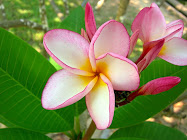
Above: Palm
Above: People's Museum Triptych
Quite a handsome building - yes? I smiled when I saw it was the People's Museum and also the Museum of Enduring Beauty. Museum of Enduring Beauty? Now what, I wondered. could that be? Beautiful ladies with smiling faces of incredible beauty dressed in soft silks, their dark hair flowing loosely? Or make-up and hair products? This, I decided, needed some investigation. So - to work.
The Museum of Enduring Beauty
The Museum of Enduring Beauty which was opened in 1996, is to create awareness of the different viewpoints held by different cultures and different periods of time on what constitutes "beauty". It is also to display exhibits to show how different cultures worldwide interpret "beauty".
The exhibition ranges from very early periods in human history to the modern era. The pictures and other exhibits reveal the differing concepts of "beauty" as practised by different cultures. Some of the exhibits reveal the pain and agony some people would have to endure to achieve the concept of beauty as visualised by their community and culture.
Among the different concepts of beauty exhibited are skin tattooing, stretching lips by the insertion of round discs, moulding heads into oval shapes and restricting the growth of feet. Ouch! Sounds painful. Tattoos, yes well, people get tattooed today, and bound feet I know was practised in China until not all that long ago. (How those poor women ever walked with their little stubs of feet I'll never know) But ladies with brass rings around their necks to elongate them and stretched ear lobes with plates.
You know something? When I look in the mirror, I don't think I look to bad after all.
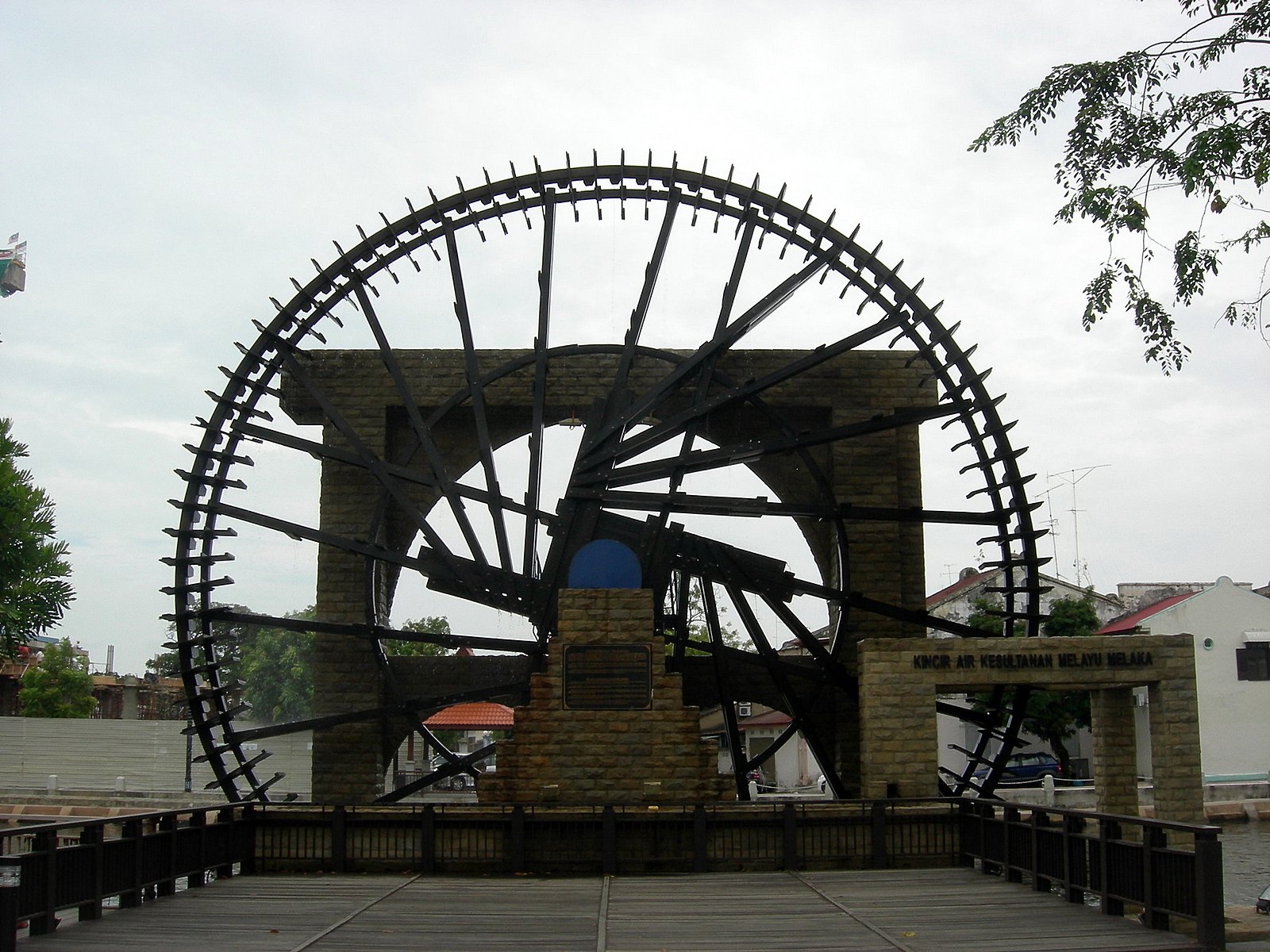
Melaka Water Wheel
Above: Water Wheel
The Malacca River is the site that witnessed the birth of the Malacca port during the Malacca Sultanate. It serves as an international port for both the East and the West including South East Asia, China, India and Europe during the 15th and 16th centuries.
It was recorded that as many as 84 languages and dialects were spoken in Malacca with four harbourmasters responsible for the welfare of the foreign traders. AT its peak, some 2,000 trading ships docked at the ancient port.
Traders from the lands of Arab, Persia, India, China Ryukyu, Philippines and Thailand gathered at the port owing to its natural strategic location. The port was located at the narrowest point of the Straits of Malacca, which was meeting point for the changing monsoon trade winds while offering protection from the typhoons from Sumatra.
The Malacca River once again witnesses history being created with the construction of the 13 metre tall water wheel of the Malacca Sultanate. The water wheel usually located in fast moving waters, was used to channel water for the large number of traders. Such water wheel technology can be found in Hama, Syria, China, India and Europe.
The construction of the replica Water Wheel of the Malacca Sultanate represents the greatness of Malacca and its technological feat for tourists to view up close. The turning of the water wheel symbolises the wheel of life and evolution of man's civilisation. Its continuous revolution represents the quest for discovery of knowledge with history to be viewed as a guide and lesson for all times.
Above: Water Wheel info
The Malacca Fort
The Malacca Fort, built in the 15th century, was a prominent landmark during the Malacca Sultanate. This was where the administrative complex and royal residences were located. The complex, guarded by armed warriors, also housed the palace, mosque and sentry towers. Laterite red stone was the main material available then and used to build and integrate the buildings in the complex. The bulk of the building material was sourced from Pulau Lupeh, Pulau Melaka, Tanjung Kling, Sebatu and Bukit Piatu.
Above: Malacca Fort
Malacca was subject to change with each successive colonial power that came to control it. In 1511, the Portuguese captured Malacca and heedlessly destroyed the Malay fortification. In 1512, the Portuguese replaced the old Malacca Center with another fort named Fortaleza de Malacca, which largely resembled the other Portuguese forts built in other parts of Asia and Africa. The Portuguese fort, completed in 1588, covered an area of 1.4 kms. On this site were located the administration building, governor's residence, hospital, quarters for employees, a church, and barracks for the army. The fort was equipped with eight bulwarks.
When the Dutch captured Malacca in 1641, they renamed the eight bulwarks: Victoria (St. Domingo), Emelia (Madre de Deus), Henriette Louyse (Onze Mille Virgines), Wilhelmus (Santiago), Mauritius (Hospital dos Pobres), Frederick Hendrik (Courassa), Ernst Casimir (Mora) and Amsterdam (Hospital Del Rey).
In 1660 and 1678, the Dutch reinforced this complex of defensive walls by building another bulwark called Middleburg, making a total of nine bulwarks.
Above: St. John Fort info
Malacca declined when the British ruled from 1795 to 1818. The Fort of Malacca that strongly attracted trading groups and commerce was destroyed in 1807, influencing residents and traders to move to Penang. The move to develop a new trading post in Penang proved a failure as it could hardly compete with the well established Malacca and its long standing trade links and flourishing reputation. While the British design was less than successful, the Fort of Malacca was soon destroyed. Only the Porta de Santiago was left intact.
Archeological excavations conducted by the Department of National Heritage in 2006 discovered the site of the Malacca Fort. Following this, the structure of the fort was revealed, making it open in 2008. The Middleburg was then reconstructed, based on archeological research and excavations, written documents, reports and discussions among local and foreign experts in the field of archeology, history, architecture and geology.
(Department of National Heritage)
Next: The Baba Nyonya Museum
Above: People's Museum Triptych
Quite a handsome building - yes? I smiled when I saw it was the People's Museum and also the Museum of Enduring Beauty. Museum of Enduring Beauty? Now what, I wondered. could that be? Beautiful ladies with smiling faces of incredible beauty dressed in soft silks, their dark hair flowing loosely? Or make-up and hair products? This, I decided, needed some investigation. So - to work.
The Museum of Enduring Beauty
The Museum of Enduring Beauty which was opened in 1996, is to create awareness of the different viewpoints held by different cultures and different periods of time on what constitutes "beauty". It is also to display exhibits to show how different cultures worldwide interpret "beauty".
The exhibition ranges from very early periods in human history to the modern era. The pictures and other exhibits reveal the differing concepts of "beauty" as practised by different cultures. Some of the exhibits reveal the pain and agony some people would have to endure to achieve the concept of beauty as visualised by their community and culture.
Among the different concepts of beauty exhibited are skin tattooing, stretching lips by the insertion of round discs, moulding heads into oval shapes and restricting the growth of feet. Ouch! Sounds painful. Tattoos, yes well, people get tattooed today, and bound feet I know was practised in China until not all that long ago. (How those poor women ever walked with their little stubs of feet I'll never know) But ladies with brass rings around their necks to elongate them and stretched ear lobes with plates.
You know something? When I look in the mirror, I don't think I look to bad after all.
Melaka Water Wheel
Above: Water Wheel
The Malacca River is the site that witnessed the birth of the Malacca port during the Malacca Sultanate. It serves as an international port for both the East and the West including South East Asia, China, India and Europe during the 15th and 16th centuries.
It was recorded that as many as 84 languages and dialects were spoken in Malacca with four harbourmasters responsible for the welfare of the foreign traders. AT its peak, some 2,000 trading ships docked at the ancient port.
Traders from the lands of Arab, Persia, India, China Ryukyu, Philippines and Thailand gathered at the port owing to its natural strategic location. The port was located at the narrowest point of the Straits of Malacca, which was meeting point for the changing monsoon trade winds while offering protection from the typhoons from Sumatra.
The Malacca River once again witnesses history being created with the construction of the 13 metre tall water wheel of the Malacca Sultanate. The water wheel usually located in fast moving waters, was used to channel water for the large number of traders. Such water wheel technology can be found in Hama, Syria, China, India and Europe.
The construction of the replica Water Wheel of the Malacca Sultanate represents the greatness of Malacca and its technological feat for tourists to view up close. The turning of the water wheel symbolises the wheel of life and evolution of man's civilisation. Its continuous revolution represents the quest for discovery of knowledge with history to be viewed as a guide and lesson for all times.
Above: Water Wheel info
The Malacca Fort
The Malacca Fort, built in the 15th century, was a prominent landmark during the Malacca Sultanate. This was where the administrative complex and royal residences were located. The complex, guarded by armed warriors, also housed the palace, mosque and sentry towers. Laterite red stone was the main material available then and used to build and integrate the buildings in the complex. The bulk of the building material was sourced from Pulau Lupeh, Pulau Melaka, Tanjung Kling, Sebatu and Bukit Piatu.
Above: Malacca Fort
Malacca was subject to change with each successive colonial power that came to control it. In 1511, the Portuguese captured Malacca and heedlessly destroyed the Malay fortification. In 1512, the Portuguese replaced the old Malacca Center with another fort named Fortaleza de Malacca, which largely resembled the other Portuguese forts built in other parts of Asia and Africa. The Portuguese fort, completed in 1588, covered an area of 1.4 kms. On this site were located the administration building, governor's residence, hospital, quarters for employees, a church, and barracks for the army. The fort was equipped with eight bulwarks.
When the Dutch captured Malacca in 1641, they renamed the eight bulwarks: Victoria (St. Domingo), Emelia (Madre de Deus), Henriette Louyse (Onze Mille Virgines), Wilhelmus (Santiago), Mauritius (Hospital dos Pobres), Frederick Hendrik (Courassa), Ernst Casimir (Mora) and Amsterdam (Hospital Del Rey).
In 1660 and 1678, the Dutch reinforced this complex of defensive walls by building another bulwark called Middleburg, making a total of nine bulwarks.
Above: St. John Fort info
Malacca declined when the British ruled from 1795 to 1818. The Fort of Malacca that strongly attracted trading groups and commerce was destroyed in 1807, influencing residents and traders to move to Penang. The move to develop a new trading post in Penang proved a failure as it could hardly compete with the well established Malacca and its long standing trade links and flourishing reputation. While the British design was less than successful, the Fort of Malacca was soon destroyed. Only the Porta de Santiago was left intact.
Archeological excavations conducted by the Department of National Heritage in 2006 discovered the site of the Malacca Fort. Following this, the structure of the fort was revealed, making it open in 2008. The Middleburg was then reconstructed, based on archeological research and excavations, written documents, reports and discussions among local and foreign experts in the field of archeology, history, architecture and geology.
(Department of National Heritage)
Next: The Baba Nyonya Museum
Saturday
112. Palace of the Malay Sultanate of Melaka
The Palace was something I really, really wanted to see. Silly me, I thought it was the actual palace where the sultans lived. It wasn't till I got here that I found out it's a replica. A brilliantly done replica too.
About
Okay now, it was built in 1984 and is a wooden replica of Sultan Mansur Shah's palace, he's the Sultan who ruled Melaka from 1456 to 1477. This building is built of only two types of hardwood, 'chengal' and 'rasak', and the roof is made of 'belian' wood. And ... no nails were used in the construction of the building, only wooden pegs. That's amazing. To think that they built this huge palace and only used wooden pegs. Wow! Bet there wouldn't be too many able to do that!
The museum cost the Malaccan government RM2.5million to build and was officially opened to the public on 17th July, 1986 by Malaysia's Prime Minister Dato' Seri Dr. Mahathir Mohamad. There's over 1,350 items including prints, photographs, drawings, and artefacts representing the history and cultural heritage of the Malay Sultanate of Malacca and the various communities who came to settle here during that period.
The palace has a ground floor (well obviously) and two upper floors and is divided into eight chambers and three galleries including chambers of the Royal band, weaponry, decorative arts, emissaries and gifts, a recreation hall, an audience hall and an Islamic hall.
IN some of the galleries, you learn about the famous clash between the legendary warriors Hang Tuah and Hang Jebat, there's these beautiful traditional costumes and the pièce de résistance - the royal bedchamber! There are a lot of exhibits - prints and photographs of the Malacca Sultanate, a model of the Sultan Mansur Shah Palace (I took a photo of that), Malay weapons, Malay traditional wedding dress, jewellery and brass ware. I remember reading about those warriors and there were models of them but my camera isn't all that good when I take indoor shots and the light is poor, so I restricted myself to taking just a few photos which I knew would come out alright.
Above: Entrance gate
You walk through this gate, the entrance fee is 2 ringgit and you get given a plastic bag for your shoes. You aren't allowed to wear shoes when you go inside (the building). I can understand that, because if you have hundreds of people all going through, the floor would get damaged. From here it's just a short walk to the palace itself.
Above: Palace of the Malay Sultanate of Malacca
I just adore the steep roof and gables - not only are they appealing to look at, the steepness aids in deflecting heat and helps in keeping the indoors cool.
Above: Front entrance
At the top of the stairs is a wooden verandah and these two fearsome warriors standing guard. I wouldn't like to upset them - those spears look awfully sharp!
You can see the beautiful detail surrounding the doorway - hand crafted designs, fancy gold leaf surround the entrance. It truly is a work of at. I wonder how many hours and how many artisans it took to create this?
Above: Scale model
For this photo, I have cropped it and chosen a wide width to better show the model. There is a sign in front with information, but unfortunately I forgot to take a photo of it.
Above: Boardgame
These two young lasses are playing a game, the name of which I do not know. It obviously isn't draughts, don't think it's chess (not that I know how to play chess). If any of you reading this know the name of the game, could you please leave a comment and let me know? It'd be really good to find out what it's called and much appreciated. (Thanks)
Above: Audience Hall
This is what is known as a diorama which is a three-dimensional full-size or miniature model. It shows the audience hall of the Sultan. In Malay, this hall is called Balairong Ser.
Above: Explanation of hall
As you can see, I've taken a photo of the information board which explains who the people are. If you click on the photo to enlarge it, you can read the writing. The left page is in Malay, the right side of the page is in English. Whilst I or you, might not know who the figures are, there can be no doubt as to which one is the Sultan! He's the chap at the very end in gold.
Above: Kris (dagger)
This is one of the daggers on display. I've translated from the information card -
"The kris or dagger, is from the Upper Peninsula and has been in use for over 600 years. The kris originated in Java."
With the introduction of firearms in the 16th century by European powers, the kris started losing popularity as a battle weapon. Today it is seen as a ceremonial piece.
Wicked looking thing isn't it? Could do a lot of damage that.☺
Above: Royal bedchamber
The pièce de résistance - the Royal Bedchamber. Ooh La La - imagine sleeping in this. Isn't it magnificent? I love the colours. And a four poster too. It ticks all the boxes!
In Malay, it is known as Balai Beradu.
Above: Sultan Mansur Syah's tombstone
There was a plaque with information about this tombstone and it reads -
The tombstone of Sultan Mansur Syah of Malacca who reigned from 1456 until his death in 1477. This tombstone was probably moved from its original place by the Portuguese in 1511 and was found on St. Paul's hill, Malacca in 1918. It was later kept in the Raffles museum Singapore and was returned to the National Museum in 1954.
This has been translated as:- "This is the consecrated the holy grave the brilliant illuminated tomb of the just Sultan, the magnanimous ruler Sultan Mansur Shah. He removed from his mortal abode on the Wednesday of rejab in the year 882 after hijrah of the prophet, the chosen one."
This has been translated as:-
The world is but transistory; the world has no permanence;;
The world is like a house made by a spider......
Above: Tun Teja's tombstone
There's a tombstone of a Malay princess near the Sultan's and I've copied the information -
Tun Teja was the daughter of Seri Amar Diraja, the Bendahara of Pahang who later became the Queen of Sultan Mahmud Shah (1488 - 1511). This tombstone is only a replica of the actual gravestone which is located at Pengkalan Samak, Merlimau about 24 km from the town of Malacca.
I couldn't help thinking about the poor Princess, no big, grand words for her even though she was a Royal, just a few simple lines. But I bet if she'd been a Prince she'd have had a far more detailed eulogy.
A Bit of Trivia
The Malacca Cultural Museum was first inaugurated in March 1954 by the then Resident Commissioner of Melaka, G.E.C. Wisdom, C.M.G., in a Dutch house built around 1660. The Cultural Museum was later moved to the Stadhuys in 1982 before it was finally moved into the Melaka Sultanate Palace.
Next: The Forbidden Garden Of The Palace Of The Malay Sultanate Of Melaka.
About
Okay now, it was built in 1984 and is a wooden replica of Sultan Mansur Shah's palace, he's the Sultan who ruled Melaka from 1456 to 1477. This building is built of only two types of hardwood, 'chengal' and 'rasak', and the roof is made of 'belian' wood. And ... no nails were used in the construction of the building, only wooden pegs. That's amazing. To think that they built this huge palace and only used wooden pegs. Wow! Bet there wouldn't be too many able to do that!
The museum cost the Malaccan government RM2.5million to build and was officially opened to the public on 17th July, 1986 by Malaysia's Prime Minister Dato' Seri Dr. Mahathir Mohamad. There's over 1,350 items including prints, photographs, drawings, and artefacts representing the history and cultural heritage of the Malay Sultanate of Malacca and the various communities who came to settle here during that period.
The palace has a ground floor (well obviously) and two upper floors and is divided into eight chambers and three galleries including chambers of the Royal band, weaponry, decorative arts, emissaries and gifts, a recreation hall, an audience hall and an Islamic hall.
IN some of the galleries, you learn about the famous clash between the legendary warriors Hang Tuah and Hang Jebat, there's these beautiful traditional costumes and the pièce de résistance - the royal bedchamber! There are a lot of exhibits - prints and photographs of the Malacca Sultanate, a model of the Sultan Mansur Shah Palace (I took a photo of that), Malay weapons, Malay traditional wedding dress, jewellery and brass ware. I remember reading about those warriors and there were models of them but my camera isn't all that good when I take indoor shots and the light is poor, so I restricted myself to taking just a few photos which I knew would come out alright.
Above: Entrance gate
You walk through this gate, the entrance fee is 2 ringgit and you get given a plastic bag for your shoes. You aren't allowed to wear shoes when you go inside (the building). I can understand that, because if you have hundreds of people all going through, the floor would get damaged. From here it's just a short walk to the palace itself.
Above: Palace of the Malay Sultanate of Malacca
I just adore the steep roof and gables - not only are they appealing to look at, the steepness aids in deflecting heat and helps in keeping the indoors cool.
Above: Front entrance
At the top of the stairs is a wooden verandah and these two fearsome warriors standing guard. I wouldn't like to upset them - those spears look awfully sharp!
You can see the beautiful detail surrounding the doorway - hand crafted designs, fancy gold leaf surround the entrance. It truly is a work of at. I wonder how many hours and how many artisans it took to create this?
Above: Scale model
For this photo, I have cropped it and chosen a wide width to better show the model. There is a sign in front with information, but unfortunately I forgot to take a photo of it.
Above: Boardgame
These two young lasses are playing a game, the name of which I do not know. It obviously isn't draughts, don't think it's chess (not that I know how to play chess). If any of you reading this know the name of the game, could you please leave a comment and let me know? It'd be really good to find out what it's called and much appreciated. (Thanks)
Above: Audience Hall
This is what is known as a diorama which is a three-dimensional full-size or miniature model. It shows the audience hall of the Sultan. In Malay, this hall is called Balairong Ser.
Above: Explanation of hall
As you can see, I've taken a photo of the information board which explains who the people are. If you click on the photo to enlarge it, you can read the writing. The left page is in Malay, the right side of the page is in English. Whilst I or you, might not know who the figures are, there can be no doubt as to which one is the Sultan! He's the chap at the very end in gold.
Above: Kris (dagger)
This is one of the daggers on display. I've translated from the information card -
"The kris or dagger, is from the Upper Peninsula and has been in use for over 600 years. The kris originated in Java."
With the introduction of firearms in the 16th century by European powers, the kris started losing popularity as a battle weapon. Today it is seen as a ceremonial piece.
Wicked looking thing isn't it? Could do a lot of damage that.☺
Above: Royal bedchamber
The pièce de résistance - the Royal Bedchamber. Ooh La La - imagine sleeping in this. Isn't it magnificent? I love the colours. And a four poster too. It ticks all the boxes!
In Malay, it is known as Balai Beradu.
Above: Sultan Mansur Syah's tombstone
There was a plaque with information about this tombstone and it reads -
The tombstone of Sultan Mansur Syah of Malacca who reigned from 1456 until his death in 1477. This tombstone was probably moved from its original place by the Portuguese in 1511 and was found on St. Paul's hill, Malacca in 1918. It was later kept in the Raffles museum Singapore and was returned to the National Museum in 1954.
The world is but transistory; the world has no permanence;;
The world is like a house made by a spider......
Above: Tun Teja's tombstone
There's a tombstone of a Malay princess near the Sultan's and I've copied the information -
Tun Teja was the daughter of Seri Amar Diraja, the Bendahara of Pahang who later became the Queen of Sultan Mahmud Shah (1488 - 1511). This tombstone is only a replica of the actual gravestone which is located at Pengkalan Samak, Merlimau about 24 km from the town of Malacca.
I couldn't help thinking about the poor Princess, no big, grand words for her even though she was a Royal, just a few simple lines. But I bet if she'd been a Prince she'd have had a far more detailed eulogy.
A Bit of Trivia
The Malacca Cultural Museum was first inaugurated in March 1954 by the then Resident Commissioner of Melaka, G.E.C. Wisdom, C.M.G., in a Dutch house built around 1660. The Cultural Museum was later moved to the Stadhuys in 1982 before it was finally moved into the Melaka Sultanate Palace.
Next: The Forbidden Garden Of The Palace Of The Malay Sultanate Of Melaka.
Tuesday
110. Bandar Hilir Walk
Saturday 20th March
Woke up at 5AM went back to sleep, then woke at 7 (AM). Had breakfast at 8.00AM - scrambled egg, sausage which was a chicken hot dog, small in size, (had I realised how tasty they were, I'd have had them when I was in Georgetown!), half a hash brown, baked beans, sliced tomato and 2 pieces of toast with butter and jam. Tea and coffee.
Tried to start a conversation with other guests but not much happened on that front. People (the guests) seemed rather stuffy - like they had a poker up their Khyber Pass! Hmmm. Nuf said.
Anyway, sitting at the table, I wrote a list in order of things to see. Dutch cemetery, Cultural Museum (Melaka Sultanate Palace), Port De Santiago (A'Formosa), the People's Museum and the Proclamation of Independence. I managed to find them all, but not in that order. I was so close and hadn't realised it - went the long way round, up, up, up all those ruddy steps to St. Paul's.
Found the Memorial by accident. Shopping complex - Dataran Pahlawan, Digital Domain North West. Went to loo (urgent) then had lunch. So readeth my diary.
Anyway......
Bandar Hilir (Lower City)
I set out, camera at hand and bottle of water in tow. Even though it was still earlyish, it was on the humid side so drinking plenty of water is necessary. I came across this lovely park.
The park was originally named Taman Merdeka and was officiated by Tunku Abdul Rahman Putra Al-Haj, the first Prime Minister of Malaysia after the Declaration of Independence Date of Malaya on his return from London on 20th February, 1956.
Bullock cart
In the early 20th century, bullocks carts were a common site in Malaysian streets - before the advent of the motor car, people used them for travel and for transporting goods. The driver and passengers sat in the front section of the two-wheeled vehicle and goods were placed in the back. These carts had a woven attap roof, and it's thought they were introduced by Indian traders during the Melaka Sultanate.
In Malacca, tourists can have a ride in a traditional bullock cart (kereta lembu)for RM10 and covers a distance of one kilometre. The carts hold up to five people. I think it'd be rather fun riding in one of these - it's something that isn't around anymore and being able to experience something of the past is always fun, although it probably wasn't considered "fun" in the old days. What is it about things that are no longer used or around that we love to see them, sit on it, ride in it, dress up in it, walk around it? There's something wistful about it all.
Note: The cart is real, the bullock are not! ☺
Taman Bunga Merdeka Bandaraya Melaka
Above: Independence Park (Taman Bunga Merdeka Bandaraya Melaka)
After a bit of hunting around, I find it is called Independence Park in English. I liked the way it was set out and it was a nice find to see the greenery and plants in a city area. Sitting under the trees was restful and being in the shade you feel a little cooler. Out comes the water bottle, I close my eyes and inhale the smell of nature on the breeze. I could sit here forever, it's just so peaceful and relaxing. But - time waits for no man and I, well I am on a schedule, a mission, to see all the things Malacca has to offer, so off I go, strength renewed.
Above: Trees
I think the topiary is quite stunning, don't you? I like the way they fit in with their surroundings. Topiary is the art of trimming and shaping trees into an interesting array of shapes and sizes to add an artistic touch. The tops of the trees look a bit like an umbrella. I like them.
Above: Red and gold pillars
These look like an entrance to a different section of the gardens. If you click on the picture to enlarge it, you'll be able to see how it is laid out and get a more detailed view of the different plantings.
I shall pause here for a moment - there was this monk, a fake monk who had been pestering me the day before for money. Joanne said he had asked her and several others for money, had tapped her on the arm and was selling things. I told her real monks don't touch women and they don't sell things. Anyway, here he was again, he had come up to me just before I entered the park, and here he is again - not a half hour later - bowl in one hand and waving these Buddhas with red tassels. I'm afraid I did the unforgivable - the thing one should never, do - I raised my voice telling him he had already asked me before and I told you no then. And I told him to bugger off. (That's Aussie slang for get lost). Oh. Then I remembered. You don't raise your voice. My eyes glanced around and I could see everybody looking at me, then quickly turn away. Oh, I should have known better. Don't raise your voice and get angry - people lose face. I sighed. But - I can tell you that was the only time, I never repeated the same mistake. Anyway.. moving on ...
Above: Commemorative marker
After walking through the red/gold pillars, I came across this marker which was on the right-hand side. The marker reads:
The launch was officiated in conjunction Gotong-Royong Melaka by Y.A.B. Datuk Seri Hj. Mohod Bin Mohod Ali Sustam Chief Menteru Malacca On Sunday 4th January, 2004. (I have translated from Malay to English).
Taman ini pada asalnya dinamakan Taman Merdeka dan telah dirasmikan oleh
Almarhum Tunku Abdul Rahman Putra Al-Haj, Perdana Menteri Malaysia yang pertama sempena Pengisytiharan Tarikh Kemerdekaan Tanah Melayu (Malaya) di Melaka sekembalinya dari London pada 20 Februari 1956)
NOTE: Gotong-/Royong means lots people working together in co-operation with one another.
Above: Reindeer
Reindeer? In Malaysia? Well not real ones obviously - they couldn't stand the heat!☺ These artistic reindeer have rope lights on them which would look very pretty when turned on. We associate reindeer with Christmas - you know, those cute little animals that pull Santa's Sleigh.
I actually had the good fortune to see a real reindeer when I was in New Zealand, this is the photo I took.
I found a poem called "We are a team of Reindeer" written by a Malaysian lady named Jacinta Ramayah so I'm including it in this post as I do think it appropriate.
We Are A Team Of Reindeer We've been Santa's favorite pets for a long while now
no dogs nor cats for him, no goats nor cows.
Eight of us in a mob, no-one knew we each had a name
then came a red-nosed mate who gave us some fame.
As the leader I, Dasher, was the first to speed ahead,
I was his captain that was what Santa usually said.
Dancer is the lightest who could land neatly on a roof
he would brake at the edge with his tiny little hoof.
Skidding and bumping, that would be good old Prancer
he is the frisky one and Santa's jolly young deer.
The wily one is Vixen, from wolves he could get away
that hid in the snow hoping we would go astray.
At the speed of a bullet, that's how Comet could fly
to make sure children slept he'd bleat a lullaby.
Cupid has the prettiest eye-lashes you ever did see
On Santa he batted them, who'd never stay angry.
An ear-splitting “Stop!” is what Donder could crack
his thunderous voice helped get us back on track.
With his keen sense of direction Blitzen knew where to go
he would take us safely through storm and snow.
Santa asked Rudolph for help and on that occasion he rose
tho' we did laugh at him, we are grateful for his nose.
There are nine of us with Santa, if you see us passing by
don't be afraid, we're a team of deer bringing you joy.
Malacca Transport Museum ~ A Plane in the Park
Imagine my surprise when I saw a plane there in the park. I didn't know then that it was part of the Malacca Transport Museum, but I wish I had because I've since found there a many exhibits from long ago to the not too distant past and I would have greatly enjoyed looking at them.
Above: Scottish Aviation Twin Pioneer FM1064
To my way of thinking, it's important to find out about things or places I've photographed and this plane was no exception. It did present quite a challenge let me tell you and it took me many hours of googling and research but eventually I did find what I was looking for.
The plane is a Scottish Aviation Twin Pioneer, Registration FM1064. The FM-1064 (cn 583) is an Ex-RMAF aircraft and was donated by the Royal Malaysian Airforce to the Malacca Transport Museum (Muzium Pengangkutan Melaka).
The Scottish Aviation Twin Pioneer was a British STOL (short takeoff and landing) transport aircraft built by Scottish Aviation Limited at Prestwick Airport, Scotland, during the 1950s. It was designed for both civil and military operators
Above: Front view
The Twin Pioneer is also powered by Alvis radials and features a high wing, but is much larger, capable of seating up to 16 passengers in the main cabin. Designed for both civil and military applications, the Twin Pioneer was also one of the few postwar aircraft to feature a high wing and tail wheel undercarriage.
The military version could carry external stores such as bombs under the stub wings. One aircraft became the first aircraft for the newly formed Royal Malaysian Air Force. FM1062 c/n580 and FM c/n581 were delivered to the Malaysian Air Force 16 January 1962 and FM1064 c/n 583 FM1065 c/n 584 were delivered two days later. The first two aircraft were taken "on charge" by No 1 Squadron Royal Malaysian Air Force. The type served with the air force for 12 years.
Royal Malaysian Air Force
The Royal Malaysian Air Force (Tentera Udara DiRaja Malaysia in Malay), was formed on 2 June 1958 as the Royal Federation of Malaya Air Force and its roots can be traced back to the Malayan Auxiliary Air Force formations of the British Royal Air Force in colonial British Malaya.
After the withdrawal of British military forces from Malaysia and Singapore at the end of 1971, a five-nation agreement between Malaysia, Singapore, New Zealand, Australia, and the United Kingdom was concluded to ensure defence against external aggression. The Royal Australian Air Force maintained two Mirage IIIO squadrons at the Butterworth Air Base as part of its commitment to the Five Power Defence Agreement. These squadrons were withdrawn in 1986, although occasional deployments of RAAF aircraft continue. From a one aircraft airforce in 1958 and a crew of 14 men, the RMAF has grown to a force it is today, with MiG-29s, F-18s and SU-30s.
Above: Royal Malaysian Air Force Crest
It was created in 1936 as Malayan Auxiliary Air Force, disbanded after World War II, reactivated in 1950. The passing of Air Force Ordinance by the Parliament on 2 June 1958 saw the creation of Royal Malayan Air Force. The first adviser was seconded from the Royal Air Force(RAF), Air Commodore A.V.R Johnstsone who became the first Chief of the Royal Malayan Air Force (RMAF). The proud few who formed the RMAF were Flying Officer Lim Heng Lip, Sergeant Subramanian, Corporal Othman Mohd Ismail, Corporal Wan Said, Corporal JD Parsley, Corporal Mahadeven, Senior Aircraftman (SAC) Surindam, SAC Md Noor, SAC Zainal, SAC Mohd Hussain and Junior Technician (JT) Ismail Ariffin.
The motto of the RMAF is "Sentiasa di angkasa raya" (English: "Always in the Airspace").
Governor's mansion
Above: Governor's mansion - built 17th century
This stately mansion was built by the Dutch and was the official residence and office of the Dutch Governor of Malacca and later the British governor under British rule. The place has a fabulous view being located on top of St. Paul's Hill.
This was also the site of the palace of Melaka Sultanate before the Portuguese. According to the Munshi Abdullah this building was known as Raja’s House. On 31st August 1957, the name was changed to Seri Melaka, as title of the Governor was also changed to Tuan Yang Terutama Yang di-Pertua Negeri.
After independence in 1957, the building remained the governor's residence until September 1996. (A new, bigger place was built in Ayer Keroh). Today, it is a museum and has been gazetted as a heritage building by the State Government.
This house is the stuff that dreams are made of and reminds me of "Gone With The Wind" - you can imagine Scarlett O'Hara running out, crinoline held off the ground with both hands running to her beau, calling, "Ashley, Ashley"!
I bags the room up the top on the left hand side. Think of the view - two sides, looking ahead plus looking out over the township of Malacca. And on a balmy summer evening, walking down the steps from the first floor to sit on the balcony sipping a cool drink watching the sunset, catching the breeze on the wind and seeing the stars come out at night.
Aren't dreams wonderful? (It helps having a good imagination!)
Malacca Islamic museum
Above: Malacca Islamic museum
The museum is only a hop, skip and a jump from Dutch Square and is opposite the Police State Contingent Headquarters. It was built in the 1850s to record the advent and development of Islam in the Peninsular and the South East Asian region. The building has been gazetted as an antiquity under the Antiquities Act 1976.
Police HQ
Above: The local cop shop
Ibu Pejabat Daerah Melaka Tengah - Police Headquarters Central Melaka District. I'm afraid I couldn't find any information about this building - what can I say? It's a lovely old white building with a blue tin roof. The middle section is double storey with detailed architectural design. The window awnings, trimmings and entrance door frame is painted a matching blue and the windows have colonial panes.
Dutch Cemetery
Above: Dutch Cemetery
The Dutch Graveyard is a small cemetery in Malacca first used in the last quarter of the 17th century. Despite its name, only five Dutch graves remain there today, and 33 belonging to British officers and their wives. The cemetery was used first by the Dutch between 1670-1682, and later by the British between 1818-1838.
St. Paul's Hill
Above: View from St. Paul's Hill
As the Dutch graveyard is at the foot of the St Paul's Hill, I climbed up the hill to get a daytime view and was rewarded with this pleasing vista. Apart from the green garden, you can see the Proclomation of Independence Memorial and Porta De Santiago (A' Famosa). The palm to the left of A'Formosa looks rather like a ferris wheel.
Porta De Santiago
Above: Porta De Santiago (A' Famosa) built 1512
The Portuguese admiral, Alfonso D’Albuquerque, built Porta de Santiago or A’Famosa in 1511. It was badly damaged during the Dutch invasion in 1641. The English were didn't really want to of maintain the fortification and ordered its destruction. It was demolished on British orders on August 10, 1807 (except for a small gate house). In 1808, Sir Stamford Raffles, a British official who had a passion for history, saved what remains of A’Famosa today. This famous landmark is located near St. Paul’s Church.
Above: Porta De Santiago canon
It's among the oldest surviving European architectural remains in Asia. The fortress had four towers, or bastions, and 2.4 metre thick walls. The towers were called Baluarte San Pedro, Baluerte de las Virgenes, Baluerte Madre de Dios, Baluerte Santo Domingo, and Baluerte de Santiago.
The Porta de Santiago, a small gate house, is the only remaining part of the fortress still standing.
Above: Gate arch
The fort changed hands in 1641 when the Dutch drove the Portuguese out of Malacca. The Dutch renovated the gate in 1670 and had the logo "ANNO 1670" inscribed on the gate's arch. Above the arch is a bas-relief logo of the Dutch East India Company.
Above: Porta De Santiago (Gate of St. James)
Porta De Santiago, or the Gate of St. James, is the sole remaining legacy of Portuguese architecture. From my research of Porta De Santiago, it seems it is erroneously called A'Formosa. A'Formosa was the name of the fortress behind this gate, not the gate itself. A'Formosa translated from the Portuguese is "The Famous". Therefore, this quite rightly should be described as the surviving gate of the A Famosa Portuguese fort in Malacca.
The Porta De Santiago was gazetted as an old building and historical site under the Antiquities Act no. 168/19776 on the 12th May, 1977.
The Proclamation of Independence Memorial
Above: Proclamation of Independence Memorial - Year Built: 1911/1912
This beautiful, ornate building with twin golden domes was originally built as the headquarters of the Malacca Club, where the British ruling class slugged gin slings, gathered for tiffin, danced an elegant waltz and played cricket. It was a bastion of British colonialism and only the best sort of people were members! There was a large field front for playing cricket or polo - both "gentlemen's" games where the ladies with large hats and gloved hands would sit under shady parasols and watch to the sounds of, "Oh I say, great shot, what". Today the field is the site of the Dataran Pahlawan Melaka Megamall.
This lovely old building today is a Memorial to Democracy where Malaysia's first prime minister announced the country's forthcoming independence on February 20, 1956. On August 31st 1985, the Proclamation of Independence Memorial was officially open to the public. The Management and administration of the Memorial has been entrusted to National Archives of Malaysia.
Above: Window detail
Much of Malacca's charm lies in its colonial architectural heritage as is evidenced by this wonderful window detail.
Above: Abdul Rahman's 1957 Chevy
In the courtyard is this gorgeous old chevy. Must have been great to have been able to ride around in them, they're such a great looking car and I just love the white trim on the tyres. The '57 Chevies are an auto icon and often restored to their original condition and sometimes modified. I was checking out the price online - do you know how much people are asking for them? From around $55,000!!! The highest price I saw was $75,000. Gee whiz, I could think of a lot better things to spend 50 thousand bucks on - think how often I could travel overseas, how many holidays I could have in Malaysia, how many other countries I could visit.
I did see one for $18,500 but that was a 2 door in "original" condition - read full of rust, parts missing, ready for the junk heap. I suppose there will be someone who will buy it and spend hours and hours and thousands of dollars to restore the old bomb.
Above: Abdul Rahman's 1957 Chevy
The chevy was bought in 1957 and was originally used as one of the many limousines provided by the government to ferry VIP's arriving at Sungai Besi airport, Kuala Lumpur to their respective hotels and rest houses. These VIP's were representatives of their countries during the independence celebration in Kuala Lumpur. The original paintwork of this car was white.
During the 1959 general elections, this car was used personally by YTM Tunku Abdul Rahman to travel the whole country in order to carry out his political campaigns.
And now we come to the last building before I crossed the road and had lunch.
Above: Bastion House - Torture Museum
Bastion House is a brick building that was built in 1910 by the British-owned company, Dunlop Rubber Company and was used solely as a business house until 1986 when it was rented out to a bank. The steep, sloping roof shows the influence of English architecture.
It's now the Malay and Islamic World Museum and houses the Museum of Torture on the ground floor.
NOTE: When researching information on this old building, one site said 'the building was named Bastion House because it is located very close to the bastions of Fortaleza de Malaca' and another site said it "might" be. I have no way of verifying this so have not included it in the above, but have mentioned it here as a possibility.
And now - it's off to lunch.
Woke up at 5AM went back to sleep, then woke at 7 (AM). Had breakfast at 8.00AM - scrambled egg, sausage which was a chicken hot dog, small in size, (had I realised how tasty they were, I'd have had them when I was in Georgetown!), half a hash brown, baked beans, sliced tomato and 2 pieces of toast with butter and jam. Tea and coffee.
Tried to start a conversation with other guests but not much happened on that front. People (the guests) seemed rather stuffy - like they had a poker up their Khyber Pass! Hmmm. Nuf said.
Anyway, sitting at the table, I wrote a list in order of things to see. Dutch cemetery, Cultural Museum (Melaka Sultanate Palace), Port De Santiago (A'Formosa), the People's Museum and the Proclamation of Independence. I managed to find them all, but not in that order. I was so close and hadn't realised it - went the long way round, up, up, up all those ruddy steps to St. Paul's.
Found the Memorial by accident. Shopping complex - Dataran Pahlawan, Digital Domain North West. Went to loo (urgent) then had lunch. So readeth my diary.
Anyway......
Bandar Hilir (Lower City)
I set out, camera at hand and bottle of water in tow. Even though it was still earlyish, it was on the humid side so drinking plenty of water is necessary. I came across this lovely park.
The park was originally named Taman Merdeka and was officiated by Tunku Abdul Rahman Putra Al-Haj, the first Prime Minister of Malaysia after the Declaration of Independence Date of Malaya on his return from London on 20th February, 1956.
Bullock cart
In the early 20th century, bullocks carts were a common site in Malaysian streets - before the advent of the motor car, people used them for travel and for transporting goods. The driver and passengers sat in the front section of the two-wheeled vehicle and goods were placed in the back. These carts had a woven attap roof, and it's thought they were introduced by Indian traders during the Melaka Sultanate.
In Malacca, tourists can have a ride in a traditional bullock cart (kereta lembu)for RM10 and covers a distance of one kilometre. The carts hold up to five people. I think it'd be rather fun riding in one of these - it's something that isn't around anymore and being able to experience something of the past is always fun, although it probably wasn't considered "fun" in the old days. What is it about things that are no longer used or around that we love to see them, sit on it, ride in it, dress up in it, walk around it? There's something wistful about it all.
Note: The cart is real, the bullock are not! ☺
Taman Bunga Merdeka Bandaraya Melaka
Above: Independence Park (Taman Bunga Merdeka Bandaraya Melaka)
After a bit of hunting around, I find it is called Independence Park in English. I liked the way it was set out and it was a nice find to see the greenery and plants in a city area. Sitting under the trees was restful and being in the shade you feel a little cooler. Out comes the water bottle, I close my eyes and inhale the smell of nature on the breeze. I could sit here forever, it's just so peaceful and relaxing. But - time waits for no man and I, well I am on a schedule, a mission, to see all the things Malacca has to offer, so off I go, strength renewed.
Above: Trees
I think the topiary is quite stunning, don't you? I like the way they fit in with their surroundings. Topiary is the art of trimming and shaping trees into an interesting array of shapes and sizes to add an artistic touch. The tops of the trees look a bit like an umbrella. I like them.
Above: Red and gold pillars
These look like an entrance to a different section of the gardens. If you click on the picture to enlarge it, you'll be able to see how it is laid out and get a more detailed view of the different plantings.
I shall pause here for a moment - there was this monk, a fake monk who had been pestering me the day before for money. Joanne said he had asked her and several others for money, had tapped her on the arm and was selling things. I told her real monks don't touch women and they don't sell things. Anyway, here he was again, he had come up to me just before I entered the park, and here he is again - not a half hour later - bowl in one hand and waving these Buddhas with red tassels. I'm afraid I did the unforgivable - the thing one should never, do - I raised my voice telling him he had already asked me before and I told you no then. And I told him to bugger off. (That's Aussie slang for get lost). Oh. Then I remembered. You don't raise your voice. My eyes glanced around and I could see everybody looking at me, then quickly turn away. Oh, I should have known better. Don't raise your voice and get angry - people lose face. I sighed. But - I can tell you that was the only time, I never repeated the same mistake. Anyway.. moving on ...
Above: Commemorative marker
After walking through the red/gold pillars, I came across this marker which was on the right-hand side. The marker reads:
The launch was officiated in conjunction Gotong-Royong Melaka by Y.A.B. Datuk Seri Hj. Mohod Bin Mohod Ali Sustam Chief Menteru Malacca On Sunday 4th January, 2004. (I have translated from Malay to English).
Taman ini pada asalnya dinamakan Taman Merdeka dan telah dirasmikan oleh
Almarhum Tunku Abdul Rahman Putra Al-Haj, Perdana Menteri Malaysia yang pertama sempena Pengisytiharan Tarikh Kemerdekaan Tanah Melayu (Malaya) di Melaka sekembalinya dari London pada 20 Februari 1956)
NOTE: Gotong-/Royong means lots people working together in co-operation with one another.
Above: Reindeer
Reindeer? In Malaysia? Well not real ones obviously - they couldn't stand the heat!☺ These artistic reindeer have rope lights on them which would look very pretty when turned on. We associate reindeer with Christmas - you know, those cute little animals that pull Santa's Sleigh.
I actually had the good fortune to see a real reindeer when I was in New Zealand, this is the photo I took.
I found a poem called "We are a team of Reindeer" written by a Malaysian lady named Jacinta Ramayah so I'm including it in this post as I do think it appropriate.
no dogs nor cats for him, no goats nor cows.
Eight of us in a mob, no-one knew we each had a name
then came a red-nosed mate who gave us some fame.
As the leader I, Dasher, was the first to speed ahead,
I was his captain that was what Santa usually said.
Dancer is the lightest who could land neatly on a roof
he would brake at the edge with his tiny little hoof.
Skidding and bumping, that would be good old Prancer
he is the frisky one and Santa's jolly young deer.
The wily one is Vixen, from wolves he could get away
that hid in the snow hoping we would go astray.
At the speed of a bullet, that's how Comet could fly
to make sure children slept he'd bleat a lullaby.
Cupid has the prettiest eye-lashes you ever did see
On Santa he batted them, who'd never stay angry.
An ear-splitting “Stop!” is what Donder could crack
his thunderous voice helped get us back on track.
With his keen sense of direction Blitzen knew where to go
he would take us safely through storm and snow.
Santa asked Rudolph for help and on that occasion he rose
tho' we did laugh at him, we are grateful for his nose.
There are nine of us with Santa, if you see us passing by
don't be afraid, we're a team of deer bringing you joy.
Malacca Transport Museum ~ A Plane in the Park
Imagine my surprise when I saw a plane there in the park. I didn't know then that it was part of the Malacca Transport Museum, but I wish I had because I've since found there a many exhibits from long ago to the not too distant past and I would have greatly enjoyed looking at them.
Above: Scottish Aviation Twin Pioneer FM1064
To my way of thinking, it's important to find out about things or places I've photographed and this plane was no exception. It did present quite a challenge let me tell you and it took me many hours of googling and research but eventually I did find what I was looking for.
The plane is a Scottish Aviation Twin Pioneer, Registration FM1064. The FM-1064 (cn 583) is an Ex-RMAF aircraft and was donated by the Royal Malaysian Airforce to the Malacca Transport Museum (Muzium Pengangkutan Melaka).
The Scottish Aviation Twin Pioneer was a British STOL (short takeoff and landing) transport aircraft built by Scottish Aviation Limited at Prestwick Airport, Scotland, during the 1950s. It was designed for both civil and military operators
Above: Front view
The Twin Pioneer is also powered by Alvis radials and features a high wing, but is much larger, capable of seating up to 16 passengers in the main cabin. Designed for both civil and military applications, the Twin Pioneer was also one of the few postwar aircraft to feature a high wing and tail wheel undercarriage.
The military version could carry external stores such as bombs under the stub wings. One aircraft became the first aircraft for the newly formed Royal Malaysian Air Force. FM1062 c/n580 and FM c/n581 were delivered to the Malaysian Air Force 16 January 1962 and FM1064 c/n 583 FM1065 c/n 584 were delivered two days later. The first two aircraft were taken "on charge" by No 1 Squadron Royal Malaysian Air Force. The type served with the air force for 12 years.
Royal Malaysian Air Force
The Royal Malaysian Air Force (Tentera Udara DiRaja Malaysia in Malay), was formed on 2 June 1958 as the Royal Federation of Malaya Air Force and its roots can be traced back to the Malayan Auxiliary Air Force formations of the British Royal Air Force in colonial British Malaya.
After the withdrawal of British military forces from Malaysia and Singapore at the end of 1971, a five-nation agreement between Malaysia, Singapore, New Zealand, Australia, and the United Kingdom was concluded to ensure defence against external aggression. The Royal Australian Air Force maintained two Mirage IIIO squadrons at the Butterworth Air Base as part of its commitment to the Five Power Defence Agreement. These squadrons were withdrawn in 1986, although occasional deployments of RAAF aircraft continue. From a one aircraft airforce in 1958 and a crew of 14 men, the RMAF has grown to a force it is today, with MiG-29s, F-18s and SU-30s.
Above: Royal Malaysian Air Force Crest
It was created in 1936 as Malayan Auxiliary Air Force, disbanded after World War II, reactivated in 1950. The passing of Air Force Ordinance by the Parliament on 2 June 1958 saw the creation of Royal Malayan Air Force. The first adviser was seconded from the Royal Air Force(RAF), Air Commodore A.V.R Johnstsone who became the first Chief of the Royal Malayan Air Force (RMAF). The proud few who formed the RMAF were Flying Officer Lim Heng Lip, Sergeant Subramanian, Corporal Othman Mohd Ismail, Corporal Wan Said, Corporal JD Parsley, Corporal Mahadeven, Senior Aircraftman (SAC) Surindam, SAC Md Noor, SAC Zainal, SAC Mohd Hussain and Junior Technician (JT) Ismail Ariffin.
The motto of the RMAF is "Sentiasa di angkasa raya" (English: "Always in the Airspace").
Governor's mansion
Above: Governor's mansion - built 17th century
This stately mansion was built by the Dutch and was the official residence and office of the Dutch Governor of Malacca and later the British governor under British rule. The place has a fabulous view being located on top of St. Paul's Hill.
This was also the site of the palace of Melaka Sultanate before the Portuguese. According to the Munshi Abdullah this building was known as Raja’s House. On 31st August 1957, the name was changed to Seri Melaka, as title of the Governor was also changed to Tuan Yang Terutama Yang di-Pertua Negeri.
After independence in 1957, the building remained the governor's residence until September 1996. (A new, bigger place was built in Ayer Keroh). Today, it is a museum and has been gazetted as a heritage building by the State Government.
This house is the stuff that dreams are made of and reminds me of "Gone With The Wind" - you can imagine Scarlett O'Hara running out, crinoline held off the ground with both hands running to her beau, calling, "Ashley, Ashley"!
I bags the room up the top on the left hand side. Think of the view - two sides, looking ahead plus looking out over the township of Malacca. And on a balmy summer evening, walking down the steps from the first floor to sit on the balcony sipping a cool drink watching the sunset, catching the breeze on the wind and seeing the stars come out at night.
Aren't dreams wonderful? (It helps having a good imagination!)
Malacca Islamic museum
Above: Malacca Islamic museum
The museum is only a hop, skip and a jump from Dutch Square and is opposite the Police State Contingent Headquarters. It was built in the 1850s to record the advent and development of Islam in the Peninsular and the South East Asian region. The building has been gazetted as an antiquity under the Antiquities Act 1976.
Police HQ
Above: The local cop shop
Ibu Pejabat Daerah Melaka Tengah - Police Headquarters Central Melaka District. I'm afraid I couldn't find any information about this building - what can I say? It's a lovely old white building with a blue tin roof. The middle section is double storey with detailed architectural design. The window awnings, trimmings and entrance door frame is painted a matching blue and the windows have colonial panes.
Dutch Cemetery
Above: Dutch Cemetery
The Dutch Graveyard is a small cemetery in Malacca first used in the last quarter of the 17th century. Despite its name, only five Dutch graves remain there today, and 33 belonging to British officers and their wives. The cemetery was used first by the Dutch between 1670-1682, and later by the British between 1818-1838.
St. Paul's Hill
Above: View from St. Paul's Hill
As the Dutch graveyard is at the foot of the St Paul's Hill, I climbed up the hill to get a daytime view and was rewarded with this pleasing vista. Apart from the green garden, you can see the Proclomation of Independence Memorial and Porta De Santiago (A' Famosa). The palm to the left of A'Formosa looks rather like a ferris wheel.
Porta De Santiago
Above: Porta De Santiago (A' Famosa) built 1512
The Portuguese admiral, Alfonso D’Albuquerque, built Porta de Santiago or A’Famosa in 1511. It was badly damaged during the Dutch invasion in 1641. The English were didn't really want to of maintain the fortification and ordered its destruction. It was demolished on British orders on August 10, 1807 (except for a small gate house). In 1808, Sir Stamford Raffles, a British official who had a passion for history, saved what remains of A’Famosa today. This famous landmark is located near St. Paul’s Church.
Above: Porta De Santiago canon
It's among the oldest surviving European architectural remains in Asia. The fortress had four towers, or bastions, and 2.4 metre thick walls. The towers were called Baluarte San Pedro, Baluerte de las Virgenes, Baluerte Madre de Dios, Baluerte Santo Domingo, and Baluerte de Santiago.
The Porta de Santiago, a small gate house, is the only remaining part of the fortress still standing.
Above: Gate arch
The fort changed hands in 1641 when the Dutch drove the Portuguese out of Malacca. The Dutch renovated the gate in 1670 and had the logo "ANNO 1670" inscribed on the gate's arch. Above the arch is a bas-relief logo of the Dutch East India Company.
Above: Porta De Santiago (Gate of St. James)
Porta De Santiago, or the Gate of St. James, is the sole remaining legacy of Portuguese architecture. From my research of Porta De Santiago, it seems it is erroneously called A'Formosa. A'Formosa was the name of the fortress behind this gate, not the gate itself. A'Formosa translated from the Portuguese is "The Famous". Therefore, this quite rightly should be described as the surviving gate of the A Famosa Portuguese fort in Malacca.
The Porta De Santiago was gazetted as an old building and historical site under the Antiquities Act no. 168/19776 on the 12th May, 1977.
The Proclamation of Independence Memorial
Above: Proclamation of Independence Memorial - Year Built: 1911/1912
This beautiful, ornate building with twin golden domes was originally built as the headquarters of the Malacca Club, where the British ruling class slugged gin slings, gathered for tiffin, danced an elegant waltz and played cricket. It was a bastion of British colonialism and only the best sort of people were members! There was a large field front for playing cricket or polo - both "gentlemen's" games where the ladies with large hats and gloved hands would sit under shady parasols and watch to the sounds of, "Oh I say, great shot, what". Today the field is the site of the Dataran Pahlawan Melaka Megamall.
This lovely old building today is a Memorial to Democracy where Malaysia's first prime minister announced the country's forthcoming independence on February 20, 1956. On August 31st 1985, the Proclamation of Independence Memorial was officially open to the public. The Management and administration of the Memorial has been entrusted to National Archives of Malaysia.
Above: Window detail
Much of Malacca's charm lies in its colonial architectural heritage as is evidenced by this wonderful window detail.
Above: Abdul Rahman's 1957 Chevy
In the courtyard is this gorgeous old chevy. Must have been great to have been able to ride around in them, they're such a great looking car and I just love the white trim on the tyres. The '57 Chevies are an auto icon and often restored to their original condition and sometimes modified. I was checking out the price online - do you know how much people are asking for them? From around $55,000!!! The highest price I saw was $75,000. Gee whiz, I could think of a lot better things to spend 50 thousand bucks on - think how often I could travel overseas, how many holidays I could have in Malaysia, how many other countries I could visit.
I did see one for $18,500 but that was a 2 door in "original" condition - read full of rust, parts missing, ready for the junk heap. I suppose there will be someone who will buy it and spend hours and hours and thousands of dollars to restore the old bomb.
Above: Abdul Rahman's 1957 Chevy
The chevy was bought in 1957 and was originally used as one of the many limousines provided by the government to ferry VIP's arriving at Sungai Besi airport, Kuala Lumpur to their respective hotels and rest houses. These VIP's were representatives of their countries during the independence celebration in Kuala Lumpur. The original paintwork of this car was white.
During the 1959 general elections, this car was used personally by YTM Tunku Abdul Rahman to travel the whole country in order to carry out his political campaigns.
And now we come to the last building before I crossed the road and had lunch.
Above: Bastion House - Torture Museum
Bastion House is a brick building that was built in 1910 by the British-owned company, Dunlop Rubber Company and was used solely as a business house until 1986 when it was rented out to a bank. The steep, sloping roof shows the influence of English architecture.
It's now the Malay and Islamic World Museum and houses the Museum of Torture on the ground floor.
NOTE: When researching information on this old building, one site said 'the building was named Bastion House because it is located very close to the bastions of Fortaleza de Malaca' and another site said it "might" be. I have no way of verifying this so have not included it in the above, but have mentioned it here as a possibility.
And now - it's off to lunch.
Thursday
90. Heritage and Culture
Georgetown - UNESCO Heritage City
Here are a few more buildings I liked. Most are heritage and were built in the 19th century or early 20th century.
Above: Leong Yin Kean Mansion
This Italian-style villa was built in 1926 by Leong Yin Kean, son of tin magnate Leong Fee. The architect was Charles Joseph Miller, and it was known back then as Leong Yin Kean's George Town Garden House. It was modelled after the opulent villas in London's Regent's Park.
Today, it is better known as "Thirty Two at the Mansion" - an upmarket restaurant housed in the building.
Above: Cathedral of the Assumption
""One of the earliest religious landmarks in Penang, the Cathedral got its name from the day the first group of Roman Catholic Eurasians from Kedah landed in Penang in 1786, which was the eve of the Feast of the Assumption."
Originally founded at Church Street by Father Garnault in 1786, the church was later moved to Farquhar Street in 1802. The building that you see today was built in 1860 by Father Manissol and because of its religious role in Penang was given the status of Cathedral in 1955.
Above: Kapitan Keling Mosque
The Kapitan Keling mosque was built at the beginning of the 19th century is the largest historic mosque in Penang. It has yellow domes and was enlarged more than once and the minaret dates back to 1916. It is the place of wirship for the Indian muslim community.
Above: Uptown Bistro
Built in 1924, the Uptown Bistro is a great pub where people enjoy the George Town nightlife. There is a live band nightly (Chinese pop) and a beer garden in the courtyard. Some years ago the building was painted purple, but thankfully has been repainted. I really like the current paint job, it's so much better don't you think?
Above: Penang Museum
The Penang State museum re-opened after a major renovation. The exhibits are organised according to the various communities in Penang, their customs and costumes, historic places, houses of worship and so on. Among the original collections on display are a hand-written Quran and old Malay weapons.
Above: Institute of Trading & Development
The photo is a little blurry as we were moving at a fairly fast pace. I haven't been able to find much information about this building other than the name.
Above: Dewan Sri Pinang
Dewan Sri Pinang is a multi-purpose auditorium built in the early 1970's and serves as a venue for live performances. It also houses the Penang State Art Gallery and showcases a permanent collection of local artists as well as special exhibitions. Although not a heritage building, I have included it here for its cultural purposes.
Here are a few more buildings I liked. Most are heritage and were built in the 19th century or early 20th century.
Above: Leong Yin Kean Mansion
This Italian-style villa was built in 1926 by Leong Yin Kean, son of tin magnate Leong Fee. The architect was Charles Joseph Miller, and it was known back then as Leong Yin Kean's George Town Garden House. It was modelled after the opulent villas in London's Regent's Park.
Today, it is better known as "Thirty Two at the Mansion" - an upmarket restaurant housed in the building.
Above: Cathedral of the Assumption
""One of the earliest religious landmarks in Penang, the Cathedral got its name from the day the first group of Roman Catholic Eurasians from Kedah landed in Penang in 1786, which was the eve of the Feast of the Assumption."
Originally founded at Church Street by Father Garnault in 1786, the church was later moved to Farquhar Street in 1802. The building that you see today was built in 1860 by Father Manissol and because of its religious role in Penang was given the status of Cathedral in 1955.
Above: Kapitan Keling Mosque
The Kapitan Keling mosque was built at the beginning of the 19th century is the largest historic mosque in Penang. It has yellow domes and was enlarged more than once and the minaret dates back to 1916. It is the place of wirship for the Indian muslim community.
Above: Uptown Bistro
Built in 1924, the Uptown Bistro is a great pub where people enjoy the George Town nightlife. There is a live band nightly (Chinese pop) and a beer garden in the courtyard. Some years ago the building was painted purple, but thankfully has been repainted. I really like the current paint job, it's so much better don't you think?
Above: Penang Museum
The Penang State museum re-opened after a major renovation. The exhibits are organised according to the various communities in Penang, their customs and costumes, historic places, houses of worship and so on. Among the original collections on display are a hand-written Quran and old Malay weapons.
Above: Institute of Trading & Development
The photo is a little blurry as we were moving at a fairly fast pace. I haven't been able to find much information about this building other than the name.
Above: Dewan Sri Pinang
Dewan Sri Pinang is a multi-purpose auditorium built in the early 1970's and serves as a venue for live performances. It also houses the Penang State Art Gallery and showcases a permanent collection of local artists as well as special exhibitions. Although not a heritage building, I have included it here for its cultural purposes.
Subscribe to:
Posts (Atom)