Pages

Flowers of Cambodia & Malaysia

Melbourne Time

Malaysia Time

Click On Your Flag To Translate

Malaysia and Cambodia

Hello,

This is about my upcoming trip to Malaysia and Cambodia. The first part is pre-trip - information about flights, itineraries, accommodation and all the things that you need to do to plan an overseas holiday. This is my first trip to Asia and I hope it may help others. Comments are very welcome and anyone who has travelled to Malaysia and/or Cambodia, please feel free to comment and offer any advice or tips that you think would be helpful. As of today ( 28th February) , in exactly 11 days (minus 30 minutes) I will be in Kuala Lumpur.
Cheers.

I had the most amazing time and hope you enjoy reading about my trip. Each post is numbered and I'm doing them in order from start to finish - a little like a diary.

ANGKOR WAT SUNRISE


Monday

105. Melaka Walking Tour

How Long and What To See
I stayed here for three nights. The "best" time to stay in Malacca is Friday, Saturday and Sunday as the Jonker Street night markets are held then and are still going on until midnight or so. The market closes earlier on a Sunday night.

I tend to disagree with going to Malacca for a day trip. When I was planning my itinerary, I'd originally planned on doing a day trip (public buses) or a day tour. Several people had advised me if you see Penang you don't really need to go to Malacca as they're pretty much the same. They were wrong.

I found that Malacca was nothing like Penang - it was completely different. A friend stayed there recently and said two nights would be best. (I had three nights, it was the end of my trip and caught the bus straight to LCCT on the Monday morning). I arrived there around 4.30pm, Friday, went to Christ Church, Stadthuys, and the area around there. If you go to St. Paul's Church you get a magnificant view of the sunset (I found this out by accident - it's the best place to watch the sunset)

Next day saw me seeing the other "sights" on that side - the Malacca Sultanate Palace (cultural museum) is a replica of Sultan Mansur Shah's palace, the famous Sultan who ruled Malacca from 1456 -1477 and is awesome - you need at least an hour there. Cost is MYR2 and they give you a plastic bag for your shoes. Most of the next day was spent in Chinatown and seeing the "attractions" there.


My Walking Tour
Armed with a map, lots of scribbled notes which I couldn't read (I'm a shocking writer - I'd never win a prize for Penmanship!) and a bottle of water, I set out on my tour to discover the delights of old Malacca. From my accommodation (Heeren House in Heeren Street), I started out with Jonker Walk.


Above: Jonker Walk
If you enlarge the photo, you can see Heeren House at the end - it has a red and white striped roof. Luckily for me, the street was pretty empty at this time so I was able to get a clear, unimpeded view. Located in the heart of Old Malacca just west of the Malacca River, Jonker Street comes alive at night.
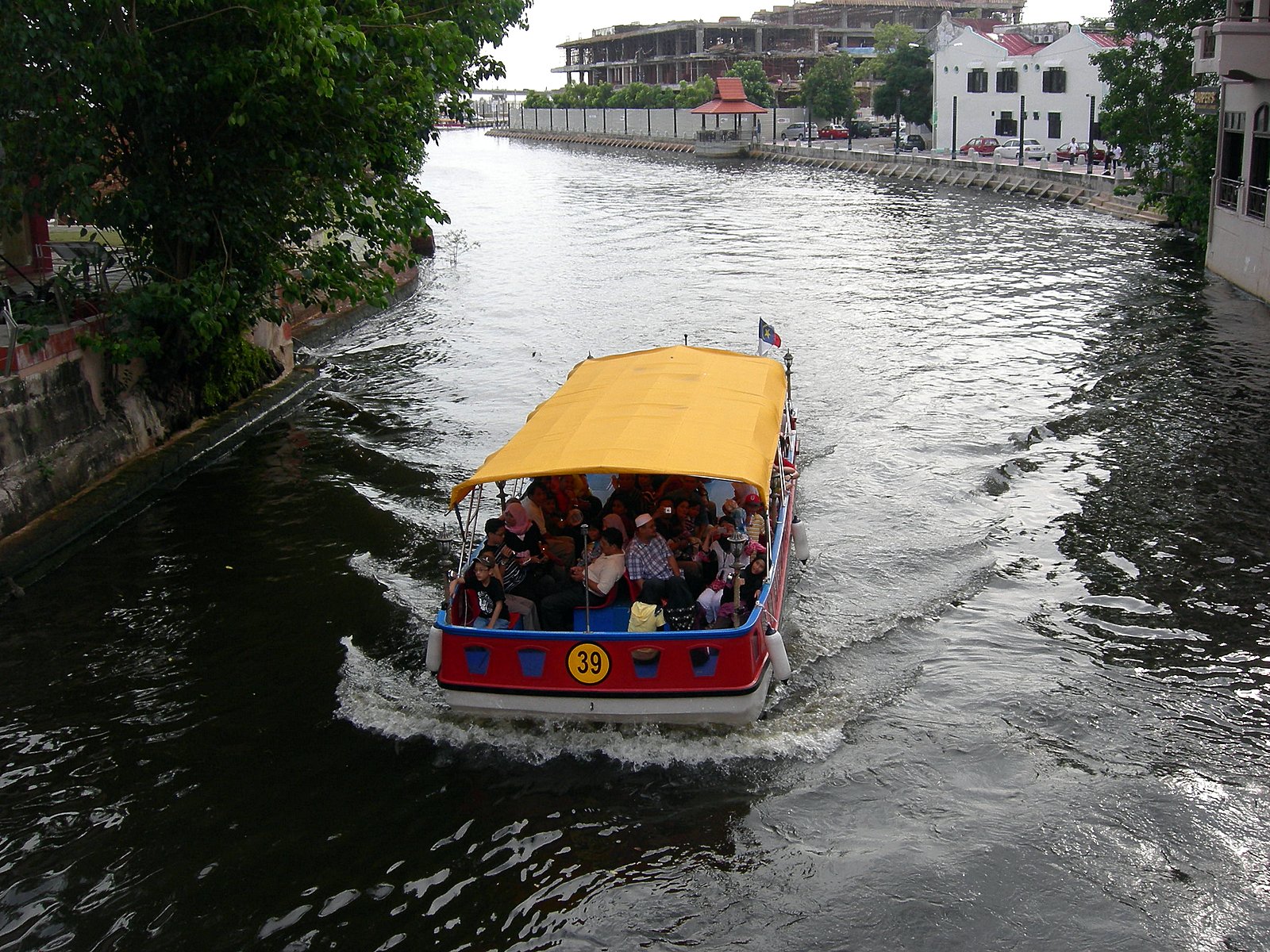

 
Above: Malacca River Cruise
It is necessary to cross over the river and as I crossed, this river boat cruise went past.


Dutch Square
I was so excited to actually be here - I've seen many photos of this area and was like a big kid in a toy shop! It was so thrilling to see these beautiful old buildings with their red brickwork and there were people everywhere milling about. Sometimes it was difficult to take a photo without everybody and his maiden aunt in the picture. But perseverance is the name of the game and the results are below.

 
Above: Dutch Square
Whoever is Lord in Malacca has his hand on the throat of Venice. (Duarte Barbosa, 16th century writer and trader).
Malacca's famous Dutch Square is in the centre of the city. Having a wonderful display of many unique Dutch mansonry and architectural skills, Dutch Square is famous for its red-painted buildings and is also known as the "Red Square."


Above: Dutch Square
Major structures in / surrounding the Dutch Sqaure include Christ Church Melaka, Studhuys, and the Tang Beng Swee Clock Tower. This is a close up of an animal sculpture - rather pretty don't you think?


Above: Tang Beng Swee Clock Tower
The Tang Beng Swee Clock Tower outside the Stadthuys was given to the people of Malacca in 1886 by Mr Tan Jiak Kim to fulfil the wishes of his father, Tan Beng Swee, who was a third generation of a Chinese philantrophic millionaire family. Tan Beng Swee, was the son of Tan Kim Seng who donated both the bridge adjacent to the clocktower and land for the Chinese cemetery. The original clock was imported from England. When the clock was replaced by one from Seiko in 1982, it caused an uproar among the senior citizens of Malacca who still recall the harsh treatment they suffered during Japan occupation. This Tang Beng Swee Clock Tower looks Dutch, but it is not. (Source Melaka Tourism)


Above: Christ Church
The church was built in 1753 and was originally the Dutch Reformed Church of Malacca, but today Christ Church is now an Anglican Church.

The pink bricks were shipped from Zeeland in the Netherlands and plastered with local red laterite and is the oldest surviving Dutch church building found outside the Netherlands. It's the oldest protestant church in Malaysia. There are Dutch tombstones on the floor and the sacramental silverware on the altar still bears the Dutch coat of arms.

Out of all the buildings here, I think Christ Church must be the most famous - certainly the most photographed. Every webpage of information about Malacca shows this church. It's my favourite building, not sure why but it just is. There is something timeless about a church - especially old churches. They seem to represent something solid and lasting.


Above: Queen Victoria's Fountain
The Queen Victoria Diamond Jubilee Fountain was erected in 1904 by the people of Malacca to commemorate Her Majesty's 60th anniversary on the British throne


Above: Melaka Art Gallery
Next to Christ Church is the Melaka Art Gallery. It was built in 1784 and was the Dutch Administrative Complex. In 1826, it was turned into a school (Malacca Free School). In  the 1920s, the building was renovated to a  double-storey building and  was later used as a post office before being converted  into the museum we see today.
The art gallery is also known as the PERZIM Art Gallery and has various artworks of local and foreign artists on display including Wan Hui-Jyu, Jehan Chan, Gerard Van Den Oetelaar, Rahmat Ramli, Rafie Abd Rahman and Rafie Abd Ghani.


Above: Trishaws
Ah trishaws - one of the most colourful and delicious confections, they are a sight for sore eyes. Beautifully decorated with flowers and whizz bang things they look gorgeous all lined up sitting in a row.


Above: Trishaws in the Square
More trishaws. No visit to Malacca is complete without a ride in one of these delightful little conveyances - everybody does it. It's something you just have to do.

 
Above: Malaysia Youth Museum
The museum is part of the Melaka Art Gallery and is dedicated to the contribution made by the youth in the economic and social well-being of the country.


Above: Melaka Tourist Police
If tourists have any problems, if you've had your bag stolen or your camera nicked this is the place to go. The tourist coppers are the ones to see - they're used to handling complaints and stuff from tourists. Fortunately I've never had the need of their services.

 
Above: Policewoman
This local copper kindly agreed to let me take her photo. (Copper is Aussie slang for a policeman/policewoman).


Above: Melaka River
Doesn't the riverside promenade look charming with its brick texture along the shop house row? And there's that river cruise boat again!


Above: Church of St. Francis Xavier - 1849
Father Farve, a Frenchman, built this Church in 1849. The Gothic towered church is dedicated to St. Francis Xavier who is well-remembered for his missionary work spreading Catholicism to South East Asia in the 16th Century.


Above: UNESCO
I came across this building on my walk and thought it deserved a quick snap of the camera.


Above: Malacca River - Jambatan Chan Koon Cheng
Another of the foot bridges crossing the Melaka River.


Above: Discovery Cafe
This is where I ended up - the Discovery Cafe where you can book bus tickets. I booked my onward bus ticket Malacca to LCCT for the following Monday morning. The place also has accommodation upstairs, and the downstairs was fair booming with life. Had I not been staying at Heeren House, this would have been a good place to stay if you like plenty of noise and life. The only downfall in my eyes is its location in nowhere near as convenient.


Above: Visitor Information Centre
Walking back, I am now back to Dutch Square. The building is quite handsome with a tiled roof complete with cupola and white balustrading at the front. We call them milk bottles" 'cos that's exactly what they look like! There's even a little balcony with seating and potted plants.


Above: Stadhuys
The largest building of all is the Stadhuys which literally means town hall in Dutch and is pronounced "stat-highs" It was built in 1650 as the office and residence of the Dutch Governor and Deputy Governor. Today, the Stadthuys is now the History and Enthnography Museum


Above: Stadhuys - side view
I took this photo looking down and was able to get the whole of the building in, It really is magnificent, there's a lot of workmanship and craftmanship went into the building of it. What a pity they don't build like this anymore. Which is why I do love the old buildings with their architecture and such attention to detail.

St. Paul's
Finally I came to the last "sight" on my agenda - St. Paul's Church. Given the already long length of this post, I was considering finishing here and writing about St. Paul's in a separate post but thought that would be silly as this post is titled "Melaka Walking Tour" and the church was the end of that tour, so here it is.

 
Above: St. Paul's Church
This church was built by a Portuguese Captain Duarte Coelho in 1521. It was a smallish chapel called Nosa Senhora - Our Lady of the Hill. The chapel was handed over to the Jesuits in 1548 and enlarged in 1556 with the addition of a second storey renamed "Annunciation".

When the Dutch took over Melaka from the Portuguese, they changed the name to St. Paul's Church - the Portuguese were Roman Catholic as are the Jesuits so the Church was therefore a Catholic Church and the Dutch being Protestants couldn't have that. Hence the name change - and used it for 112 years until their own church (Christ Church was built). The old church was then subsequently deconsecrated and the nave was used as a burial ground.

 
Above: A closer look
St. Paul's Church lost its tower when the British took over but had one new feature added to it - the lighthouse at the front. Not a very religious lot, the British - they didn't use the church to worship and pray - they used it to store gunpowder. They also erected a tall flagpole and renamed the hill on which the church stands to Flagstaff Hill (Bukit Bendera), but the name however didn't last. The flagpole was taken down and the church abandoned.


Above: Statue of St. Francis Xavier
St. Francis Xavier was born Francisco de Jasso y Azpilicueta (7 April 1506 – 3 December 1552) in Navarre (now Spain) and was a pioneering Roman Catholic missionary and co-founder of the Society of Jesus. He led an extensive mission into Asia, and brought Christianity and Catholicism to the area. He is known as the Apostle of the East.

He died in China in 1553 and his body was sent back to Malacca, where it was interred there for nine months. When the body was transferred to Goa, the exhumation was quite surprising - even though he had been buried for nine months, his body showed little sign of decay. The right forearm, which Xavier used to bless and baptise his converts, was detached by Pr. Gen. Claudio Acquaviva in 1614 and sent to Rome at the Pope's request. Blood was said to have gushed out of the arm even though he had been dead for 62 years. Francis Xavier was cannonised a Saint in 1622 and what remained of his right arm in Rome was merely skeleton, but the body in Goa remained incorrupt minus the right arm.

In 1952 the Bishop of Macau decided to put a statue of St. Francis Xavier in front of St Paul's Church. A carars marble statue was ordered from Italy and was sculptured by the famous Italian sculpture, G.Toni and was ready for the forth centenary celebrations on the 22 March 1953. One night a huge tree fell, burying the statue. On clearing the branches, the statue was found to be intact except for the right arm which had broken off.


Above: Closeup of the arch
Old tombstones line the sides of the ruins.


Above: Dutch tombstone

The tombstone reads,

HIERLEY T BEGRAVEN HENDRIK
SCHENKENBERGH INSYNLEVEN
OPPER-COOPMAN EN TWEEDE
PERSOON DERSTADEN FORTRESSE
MALACCA OVERLEDEN DEN
29 IUNY 1671


Above: St. Francis Xavier's former burial place
The famous Spanish-born Jesuit missionary St. Francis Xavier was a regular visitor to the church from 1545 to 1552 and when he died his body was interred here for nine months before being exhumed and taken to his final resting place in Goa, India. A statue of St. Francis was built in 1952 to commemorate his passing and internment here.

The St. Paul's church ruins were gazetted as an old monument and historical site under the Antiquities Act No. 168/1976 on May 12, 1977.


Sunday

104. Malacca
Arrival in Malacca
Having left the town of Tanah Rata in the Cameron Highlands early in the morning, we arrived in Kuala Lumpur around 1.00PM - it was hot, humid and smelly. (All those buses emitting exdaust fumes). A far cry from the Highlands. The bus to Melaka left at 1.30PM and arrived at 4.00PM. I caught a taxi from Melaka Sentral for the final leg. After checking into my accommodation, I did a "walking tour."

About Malacca
Like Georgetown in Penang, Malacca is also included in UNESCO’s list of World Heritage Sites under the category “Historic Cities of the Straits of Malacca.” (Malacca city centre was listed as a UNESCO World Heritage Site on 7 July 2008.) Some five hundred years ago, both Georgetown and Malacca were major trading ports which linked the east with the west and the multi-cultural heritage and tradition of Asia, and European influences still survives to this day - you can see this in the beautiful colonial buildings and architecture.

While Georgetown symbolises the British-colonial era from the late 18th century, Malacca represents the characteristics of the Dutch and Portuguese eras from the 15th-century Malay Sultanate. Known for its historical prominence and cultural appeal, Malacca of the 16th century was the foremost maritime trading centre in the region and was so desirously sought after by the European powers that is was successively ruled by the Portuguese (1511 - 1641), the Dutch (1641 - 1824), and British until the Federation of Malaysia was formed on 31st August, 1957 when it gained independence.


What's In a Name ~ Malacca or Melaka?
Malacca is the name I have always known (the city is commonly known as Malacca in English) - Melaka is the Malay name, and was known as Malaqua to the Europeans in the 1500's. An English woman married to a Malaysian man for many years whom I met in Malacca, to my question, "Which is correct - Malacca or Melaka?", replied that when she first came to live there it was known as Malacca and the Malaysian government changed it to Melaka because "it sounded more Malaysian" but she disagrees with this and still spells it Malacca.

When researching online, I have found that the place is spelled as "Malacca" more often than as "Melaka" - even in Wikipedia it is referred to as "Malacca." Which is correct or more correct? I should think it would depend on your point of view wouldn't it? There will be those who will always refer to this place as Malacca just as there are no doubt those who refer to it as Melaka. To satisfy both camps, under "labels" in the sidebar, I have listed it as Malacca/Melaka.


Saturday

103. Goodbye to the Cameron Highlands

We arrived back in Tanah Rata after visiting the tea plantation and I went straight into town to ask (again) for a refund.

Liar, Liar, Pants on Fire!

You may recall the trouble I had in getting a refund, I wrote about it here (post 96). Well, the so called boss "Karen" still wasn't there (why am I not surprised?) and some rude bloke - stupid git, lied. He said, "According to the International Law for tourists when you have paid there is no refund." What a load of bulltish - the idiot even argued there was such a law. Had he said he spoke with his boss, but they don't refund, it would have at least been honest.
The giving of refunds is up to the owner/boss - were they concerned about the quality and good name they'd refund as a good PR policy.

 
Above: Kangs Hotel
My advice - stay away from them. If I'm lucky enough to return to Malaysia, I wouldn't stay with Kangs - I wouldn't trust them with a ten foot barge pole. They have two places - the hotel which is in the main street and the lodge which is in a side street. There are a lot nicer places to stay which are clean.


Time for Coffee

I fortified myself with a cappuccino from Starbucks (personally I loathe Starbucks and don't buy my coffee from them back home ever, but here in Malaysia, it's the only place you can get a cappuccino) and sat outside sipping it. At 10 MYR it's not really cheap - about the same price as back home, but hey! I'm not complaining.
After this I walked back to the Inn and had tea. Sitting outside at the outdoor tables and chairs, I met a very interesting fellow called Greg, a Canadian who collects (and works with) butterflies. He did have lots of interesting tales about the CIA ("Central Idiots Agency"), Bush, 911 etc.
Ordered tea at 8.00 - I still haven't had a shower, meant to have one about 5 while it was still warm. Must have one after dinner and pack my suitcase. Dinner was fried noodles with egg and vegetables. And "French fries". The noodles looked and tasted like 2 minute noodles - disappointing really - the "French fries" were frozen crinkle cut chips. I wished I hadn't ordered either - should have gone for the rice. Total cost 9.50 MYR. Ganesh, the owner said go to Room 7 to order (the two girls working sleep there) - they didn't look too pleased - one was in pj's, the other just had a towel wrapped around her. But the menu list says 1PM to 9PM. Perhaps they couldn't tell the time or their watches were fast. It's funny what comes back to you when you start reading what you'd written two years ago isn't it? If I hadn't written all this down, I never would have been making this post like this that's for sure. So the moral is - Write it Down! Write it Down!


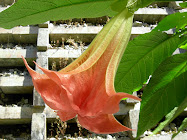
Above: Datura - Angels Trumpet
I took this photo that evening while sitting outside my room. They are a most beautiful flower with velvety looking petals and large, shiny dark green leaves but beware - for all their beauty, they are deadly. Along with Deadly Nightshade, Mandrake and Henbane, Datura belongs to the classic "witches' weeds." Most parts of the plants contain toxic hallucinogens, and datura has a long history of use for causing delirious states and death. It was well known as an essential ingredient of love potions and witches' brews!


Above: One very big mossie!
And there was this humungous mosquito - she looks like a bomber getting ready for attack! I remember when I saw it, thinking of the Australian song "Little Aussie Mossie" - we have songs about just about anything and this one is one of my favourites. (The song, not the mossie)
There's a little Ausse mossie in her little Ausse cossie,
And she's lookin' for a possie on your unprotected skin,
When she's finished her inspection
She will give you an injection
You'll have an itch to show you where the Aussie mossie's been.
There's a great proliferation of the mossie population
It's a constant irritation to as all
Yes it's hard to feel affection
When she heads in your direction
For the little Aussie mossie is out to get us all.

It wouldn't matter whether it's an Aussie mossie or a Malaysian mossie - they're all the same.
I uploaded it to YouTube - You can listen to the song here.


Time to Leave
It's Friday the 19th and all too soon it was time to leave. After having toast for breaky - cost 160.90 MYR, I said my goodbyes and headed off to the bus stop. The bus was on time and a very comfortable VIP coach. Instead if having two rows of seats either side with a middle aisle, there is only one row of seats down the left side and two on the other side. This meant the seats were spacious and there was plenty of leg room - you can see this in the photo below.

 
Above: VIP Bus
I had the front seat on the left side of the bus (in the photo it's on the right). We had these lovely curtains with bobbles and tails too - a vehicle fit for royalty. There were two stuck-up Americans next door (seats to my right) from Florida who were so far up themselves that I'm sure they'd get a stiff neck!


Above: Touch'n'Go
One of the Touch'n'Gos along the highways - you have to pay to use the roads.


Above: Last photo of the Cameron Highlands
This is the last photo and last look at the Cameron Highlands - a nice interlude where the weather is pleasant, no humidity, green hills and lots of fresh air.


102. Sungei Palas Tea Plantation

Above: Billy Goat

We passed a few goats on the way to our next stop. This fellow was munching away on the grass on a hill.


Above: Three Billy Goats Gruff

A little further on were these kids. The same family perhaps?


Above: Information

At an altitude of 1500 metres above sea-level and covering around 235 hectares, the Sungei Palas tea factory is one of the most popular attractions with tourists and visitors. The air is clean and fresh and the grounds extensive.


Did you know?

Tea used to be plucked by hand as the workers move laboriously through the long rows of low tea bushes.

Today, the most common plucking method used is the two-man hand-held machine which is assisted by winches. These machines can harvest up to 300 kgs of green leaf per man per day, 10 times more than traditional hand plucking.

On the steepest slopes where access is limited, shears are used and can bring in about 120kgs per man per day.

After the harvest day is over, the leaf is first checked for quality, packed into sacks and weighed before being transported to the factory for processing.


The Manufacturing Process of Tea

We were taken on a tour of the factory and our guide explained the fascinating details of tea - from plant to packed in boxes for sale.


Harvesting

Tea bushes are harvested approximately every three weeks. The leaves are picked in the morning and immediately transported to the factory. Tea leaves are plucked only after two years from planting. Once the plant is mature, tea is plucked approximately every three weeks. The plucked leaves are checked for quality and are then transferred to the factory where they go through five main processing stages. Each stage brings out the distinctive fragrance and aroma from the tea leaves.


Withering

During this first step, the green leaf is withered to reduce moisture and allow natural chemical reactions to take place by putting them in troughs or bins with warm dry air running through them for about 12 to 20 hours. This is usually done overnight.


Rolling

The withered leaves are rolled to crush the leaf cells and process them into smaller particles. It also exposes the cells to oxygen. The rollers used at the factory date back to 1935.


Fermentation

Also known as oxidation, fermentation is the natural chemical process in which enzymes in the leaf are exposed to oxygen. This is the stage that determines the flavour, aroma and colour of the tea. The leaves are spread onto trays and the humidity, temperature and timing are carefully controlled. After fermentation, the tea leaves change from green to copper. This process takes from two to three hours.


Above: Drying the leaves


Drying

Drying stops the fermentation process and reduces the moisture in the leaf to 3%. The fermented leaf is fed into machines through which blasts of hot air heated to almost 120º Celsius is passed through the leaves.

The tea leaf then emerges into the familiar crisp black curled form we see and is known as "made tea." The process is completed in around 10 - 20 minutes. The furnace uses wood from the rubber trees to produce the hot air.


Sorting

After drying, the "made tea" is graded according to size. This is done by passing the leaves through several sieves known as vibroscreens. The fibres, stalks and off-grades are removed during this stage and each grade of tea has its own flavour, characteristics and density.


Tea Tasting

Tea tasting is a vital and essential part of the tea making process and is very specialised and requires years of training - like a wine taster. The taster examines each sample of dry tea leaves for texture, colour, amount of twist and evenness of grade. The infused leaves are then examined for colour, brightness and uniformity. Next, he or she tastes the tea for taste, flavour and aroma.


Above: A nice hot cup of tea


Storage

The tea is then stored in dry conditions to mature and mellow further before packing. It is important that to ensure there is no moisture as this would ruin the tea.


Packaging

The tea leaves are packaged into boxes and other containers and are now ready for the market.


Above: The five stages


The factory produces 600,000 kg of tea a year and has a variety of different brews - Pekoe, Cheeding, Palas Supreme, Cinnamon-flavoured. It is open Tuesday to Sunday from 9.00am to 4.30pm. Admission to the factory is free and tours are conducted every 30 minutes.


Above: Welcome sign


Above: Sungei Palas Tea Centre

The Sungei Palas Tea Centre is an airy and spacious complex housing a visitor gallery, tea shop, a cafe and museum.


History

During the British colonial ear in Malays, a Mr. J. Russel, a British businessman, started the BOH Plantations in 1929. Due to huge demands for tea coupled with the climate of the Cameron Highlands, he saw the potential and economic value and was granted a concession of land for his first tea garden in Habu.


Today, BOH Plantations has three tea gardens - Habu, (the first one), Fairlie and Sungei Palas Tea Garden. A packaging factory was set up neat the main garden - this ensured the freshness of their products. BOH tea products are distributed not only to the domestic market but also internationally.


Scenic Tea Gardens

Below are some shots I took of the beautiful gardens with their manicured rows


Above: BOH Tea


Above: Sungei Palas Gardens


Above: BOH Tea Plantation


Above: Tea plantation with coffee trees


Above: Sungei Palas Tea Plantation


Above: Restaurant exterior


Above: Friends

Sitting in the cafe drinking tea, the young man and his family were sitting next to me. We got to chatting - he taught me a few Malay phrases, and I told him a few Aussie slang words. His little sister was (I think) about eight or nine.


It was a lovely day and visiting the tea plantation was a real eye-opener - whoever would have thought there would be that much intensity involved in producing tea?

Sunday

101. Mossy Forest

Above: Ginger plant
After seeing Mt. Brinchang, we walked a short way down the hill and entered the mossy forest on the left which is approx. 2,000 metres above sea level. This little ginger plant

Above: Nick, our guide
Nick was very good at showing us leaves and plants and explaining what their use was. Alas, I misremember the name of many, including this one, other than it is some sort of palm.

Above: Pitcher plant (Nepenthes alba)
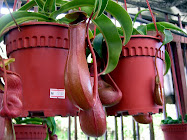
One of the many pitcher plants. These plants live off insects in the forest attracting them in with a sweet nectar.

Above: Pitcher plant (Tolong Jangan Sentuh)
Once the insect is trapped then it's Kbang! - the lid (trap) closes shut and its prey is caught. More information about these plants can be found here.

Above: Fatimah's plant - (Labisia Pumila)
In Malaysia, Labisia pumila is popularly known locally as Selusuh Fatimah

Labisia pumila (Myrsinaceae), popularly known as "Kacip Fatimah", has been used by many generation of the Malay women to induce and facilitate childbirth as well as a post-partum medicine


Kacip Fatimah has been traditionally used by the Malay women for many generations in childbirth in inducing and eases delivery, as a post partum medication to help contract the birth channel, to regain body strength, regulate menstrual cycle and avoid painful or difficult menstration, and to alleviate menopausal symptoms. The plant is traditionally boiled and the water extraction is taken as a drink. Other traditional uses include treating dysentery, rheumatism, and gennoehoea. It is also used as antiflatulence by helping to drive away and prevent the formation of gas. The plant will also help to firm and tone the abdominal muscles. Scientific studies have established that the medicinal properties and biological activities of Kacip Fatimah are due to the presence of phyto-estrogen (plant estrogen) that is naturally found in the plant.

Above: Boundary marker Pahang/Perak
It was fun to stand here with a foot on both sides of the border.


Above: Gazebo?
This charming little gazebo was down the hill a bit after we exited the forest.
Related Posts Plugin for WordPress, Blogger...